I watched the video (I’d never seen one of his videos before). Coincidentally, I’ve been working recently with Intellijel Plonk, the last module to enter my rack (through a trade, I’m not sure I would have bought it otherwise), which was a collaboration with AAS and contains some DNA from Chromaphone 3, ranked highly in the video. I am quite enjoying what can be done with Plonk. My comment was more about frustration with the ubiquity of MI code than any real fear that innovation in software synthesis was dead.
2 Likes
Usually any approach to simulating a real instrument gets artifacts that sound a little off whether it’s samples, physical modelling, or a combination of the two.
This is very much a YMMV thing and there are people that love SWAM and use it over the onboard SuperNATURAL sounds on the Aerophone Pro whereas I’m the complete opposite and seem to pick up on the SWAM artifacts.
When it comes to the real accoustic instrument sounds, there’s strengths and weaknesses to each sound engine and usually you’ll find a particular sound engine does some sounds amazing and some sound terrible to you.
That said with skill and the right instrument (usually not a keyboard) some of the SWAM stuff can sound good:
1 Like
Isn’t it hilarious that first @Jeanne assesses all the strings sounds as saxophone, and then @adamc shares an impressive video of strings sound played by… a saxophonist? 
(Please keep the interesting conversation, I just couldn’t stop myself from interjecting.)
2 Likes

Though it doesn’t sound like a violin either 

What makes all those solutions easy to spot are the radical changes in timbre (especially the attacks) that occur, which do never occur with a real instrument.
Like, 1:15 - the a-string sounds somewhat like a violin, the d-string more like a cheap violoncello …
Edit: The best parts are the higher strings, where the timbre indeed sounds like a violin, but we still have a performance that does not sound right in how the notes are connected, for example.
1 Like
I said it can sound good but it’s all going to be imperfect in some fashion.
It will never fool someone with intimate familiarity of the acoustic instrument in question.
A saxophonist will always say the sax patches sound fake.
A trumpet player will always say the trumpet patches sound fake.
etc.
1 Like
That’s the big problem of physical modeling today, people only want to replicate the sound of existing instruments. For that, it’s really not interesting at all.
It’s much much more interesting when physical modeling tries to replicate the behavior of real instruments with all the possibilities of synths. Unfortunately it’s very rare. Modalys for MaxMSP tries to do that and it’s really good, if you know Max.
On the hardware side, the only synths I know that do this if you push them far are the Yamaha VL1 and VL70m. Of course you have to dig deep with these to find something interesting but when you do, oh man. The VL70m is the only synth, hardware or software, that give me the sensation to play a real instrument, not because of the sound but because of the behavior. For example, this means if I blow harder with my Sylphyo, I can make the sound “crack”, like when you play a reed instrument. There’s a lot of surprises like when you play a real instrument.
I think physical modeling is the future, but there’s a lot to do. I don’t want to play your f*cking buttery trumpet that sounds like an 80s synth, I want to play a sound that behaves like a trumpet, ya know what I mean ?
3 Likes
And I agree, I modified my post a bit
1 Like
This is how I use my Opsix, I create sounds I imagine I would do on an Yamaha VL1 
For acoustic instruments, I work together with players of acoustic instruments.
1 Like
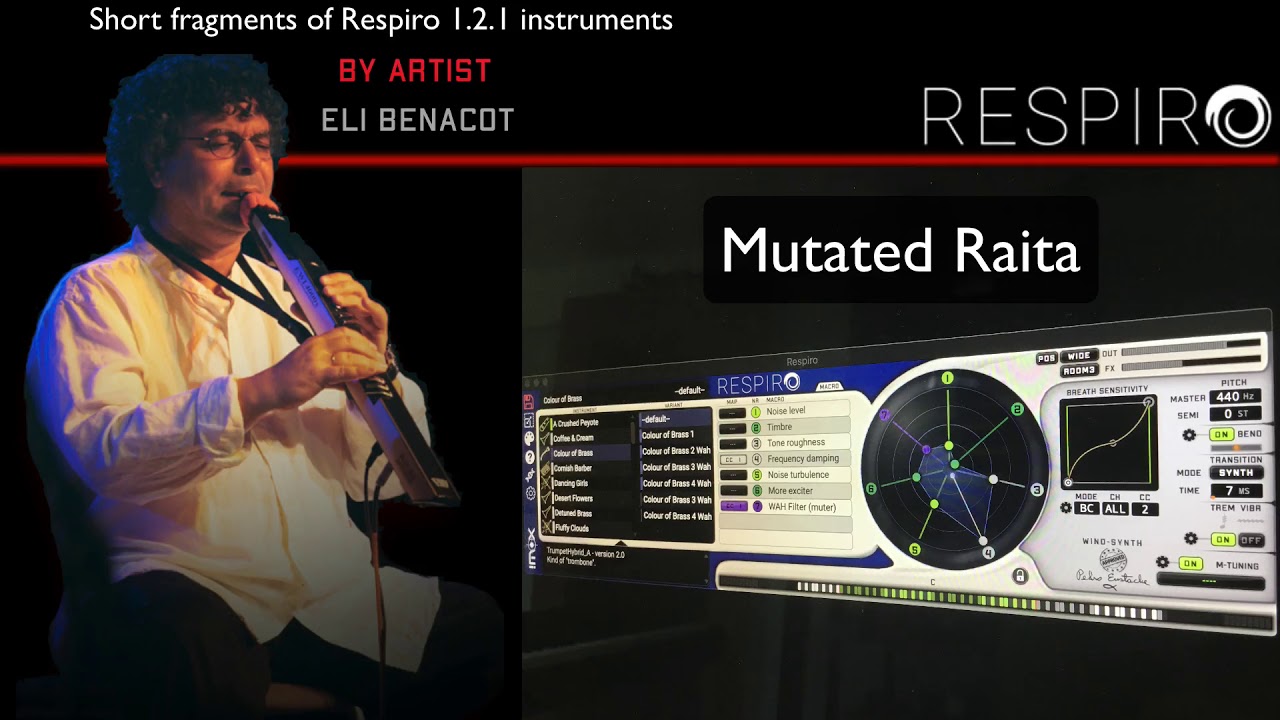
IMO Imoxplus Respiro is probably the best one with this approach in software at the moment:
1 Like
Yeah but that’s still FM. It’s not what I’m after. Here’s an image of the VL70m editor : embouchure, reed driver, throat, breath noise, lip collision… THESE are the parameters I like ! Physical modeling synthesis can be much more complex than FM synthesis.
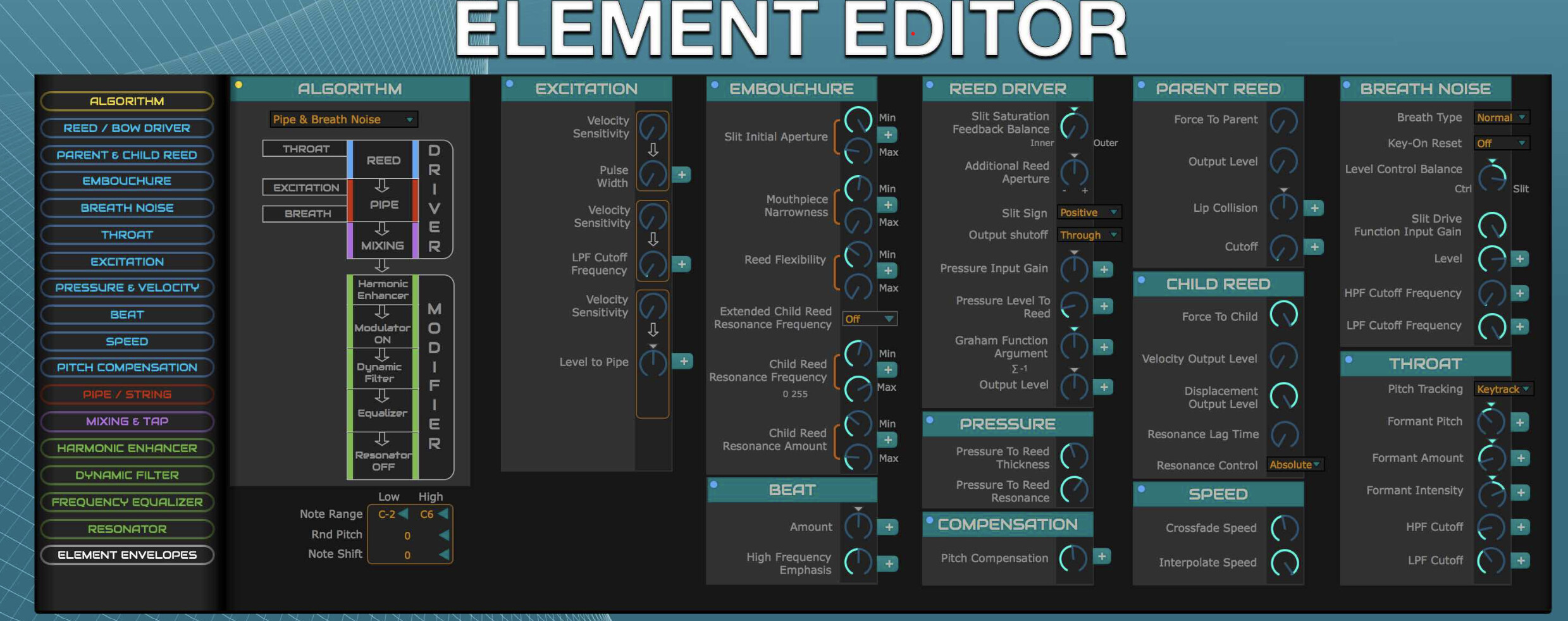
I know that, I have Respiro, but it still not enough. For example, you cannot edit the patches yourself. These are premade patches that you can just tweak a little bit. I asked Imoxplus if he could add that, but he says it’s not possible with Respiro unfortunately. So, the Yamahas are the beasts. And the VL70m editor is made by the same guy that made Respiro.
Same here, my point was that I don’t have an Yamaha VL either and a heavy imphasis on “imagine” (in the sense of “fantasy”) 
1 Like
The Yamaha VL1 is my Monomachine holy grail.
1 Like
ditto @.@

1 Like
At least half of the sound is due to the expressive controller. With only keys, you need to do a lot of sample magic to make it sound convincing. For example, a violin lives of a lot of vibrato and microtonal sound. This alone is impossible to do with only keys, Osmose excluded.
I’d be totally into an Elektron physical-modeling -takt.
3 Likes
An expressive controller provides more ready access to the sound but as you get patches with more depth, learning to play within a patch becomes increasingly important and requires more work.
On the wind controllers switching from patch to patch each tends to require slightly different tonguing and breath envelope control to get the best response.
That’s also just the basics for the patch.
To make it sound like a real instrument would include understanding how that instrument would phrase things and the stuff that is and isn’t possible for that instrument.
1 Like
Yes, there is a learning curve to controlling the expressive behaviour of any sound, to the same extent as there a learning curve to sound design. But a realistic tone alone won’t make a convincing saxophone.
The key question is of course whether the point is to emulate another instrument at any cost or to just sound “more alive” as a keyboardist.
EaganMatrix for example offers a physical model of a spring. This provides for astonishingly interesting sounds.
1 Like
Back to the Omega, I wish there would be a possibility for the developers and/or for the users to improve and expand the initial software through collaboration/expansions, but I have no idea what this means at the OS development level, leave alone at the commercial level. It is clear that Aodyo is a small company and they are busy building a hardware synth, but it would be great if there would be a technical chance for others to add their work out of their own commercial interest.
If not… open source algorithms it is (which is the best scenario, but usually takes more time and unplanned factors like a company shutting down or a skilled developer having plenty of time).