[quote=“” snowcrash""]
I did some math on the delay times and how they relate to measures, metrics and rhythm… also helps which numbers could be useful etc… I don’t know if I did any mistakes (I’m unsure about the parameter-range since I’m not with my A4 right now). Also I didn’t check if this values work out on the actual machine. If someone finds the time, to test this, I’d be glad to update the link…
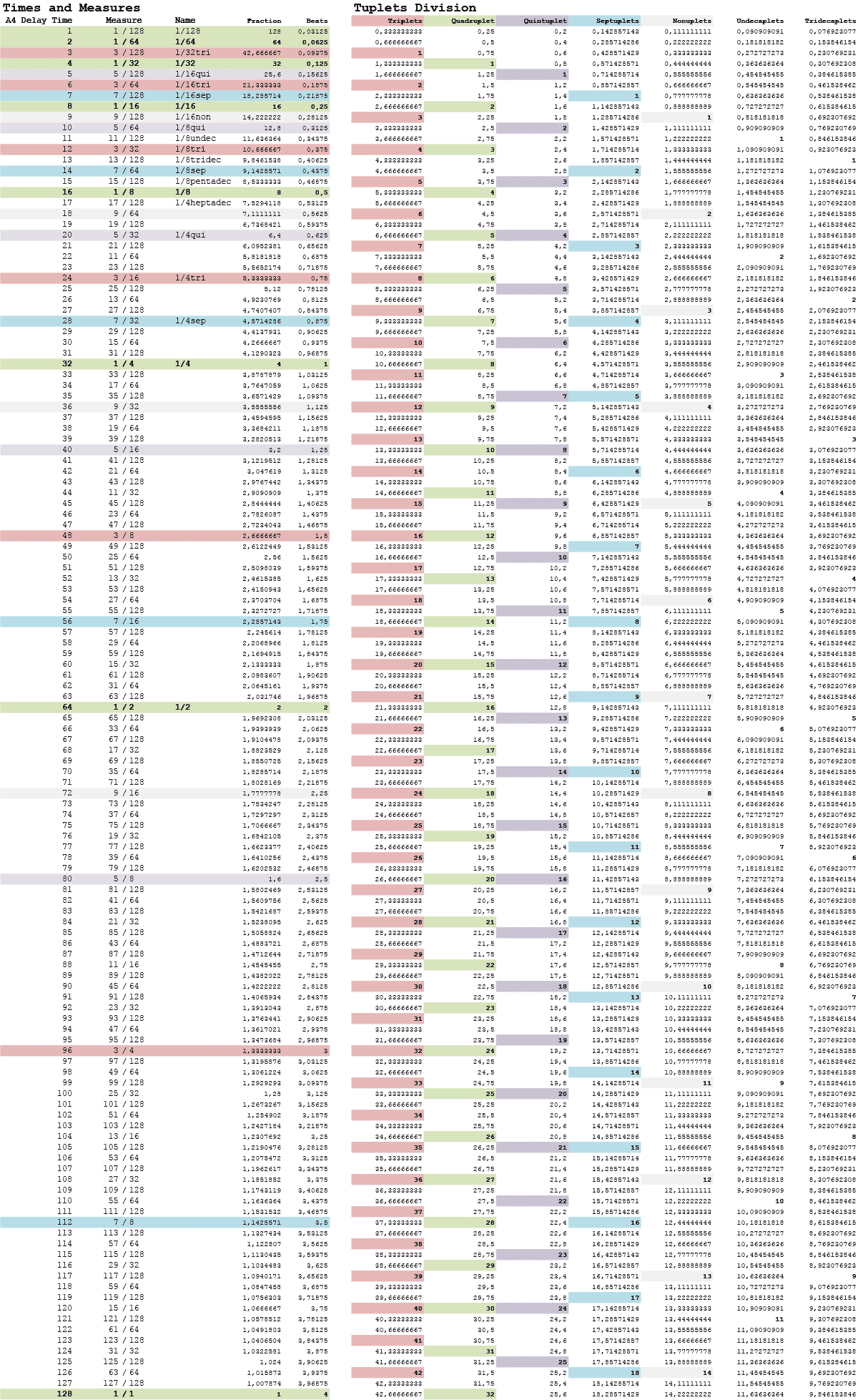
PDF Version:
https://dl.dropboxusercontent.com/u/6245022/Gnankn/A4DelayTimeMath.v0.1.pdf
[/quote]
First of all thanks for creating this chart, really cleared up the delay for me! The colour coding is awesome too.
I think I found something inaccurate in here, though. Maybe it’s me that is looking at this the wrong way, I guess we’ll see…
What i mean concerns the the triplets in the chart. I think that the red lines, the supposed triplets, are actually dotted notes. Let’s put this hypothesis to the test:
1 dotted 1/8th-note = 1/8th-note*1,5 = 3/16
or numerically:
0,5 [beats] *1,5 = 0,75
The resulting values (0,75; 3/16) show up in the same line in the chart. That line is labelled “1/4tri[plet]”. Unless I have taken a wrong corner in my thought process here, I think that label should be “dotted 1/8”.
Maybe the reason why this got mixed up was that, if you look at the chart, the column “fraction”, which shows the most reduced fraction, does have numbers with periodical ,3333 ,66666 (e.g. 3/32 = 1/10,666666…). Of course this looks like we’ve got a triplet, but not really actually. The ,333 or ,6666 needs to be the in the column “beats” to make it a triplet
I was bummed when I discovered this because i quickly realised there are no triplets at all in the delay on the A4.
An 1/8 triplet would have to be 1/12, which simply doesn’t appear between 1/128 (the increments of the delay) an 128/128. (That’s basically saying 1/12 and 1/128 don’t have a common denominator).
Oh well, doted notes sound great too 
Oh and just an afterthought:
I haven’t looked at the other -plets…
EDIT: Dunno what these findings means for the quintuplets etc. in the chart.
EDIT: It was Lars Erik that got me on this idea with this post: Delay & Tempo Sync - #7 by matic