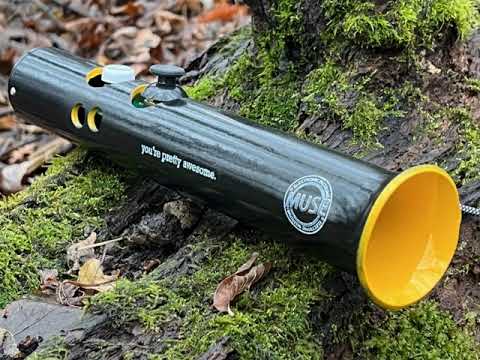
I must say, the audio of this is the best sounding simulation of a real instrument i have ever heard. Sounds like a Native American flute for real. Usually electronic wind synths trying to sound “real” has no interest for me, but not in this case. Would be interested in the MIDI this generates as well.
Inexpensive and open source.
Simple to control, it senses the size of the mouth cavity for pitch, so similar to whistling, and then two other simple controls.
I like the design of Warbl 2. The custom fingering support and fingering chart tool looks very useful. I like pitch bend by finger distance fro the hole.
I wonder if there will be a deal bundling Warbl 2 with Eagan Matrix Micro when the latter product is officially released, since Haken states it was designed with Warbl in mind. I don’t play the speculation game very well, but the photo makes me guess that an app will be required to configure settings in this Micro, and that a front panel UI (display, knobs, etc.) was omitted to maximize cost savings. As noted in the Micro thread, no CV either, but as a little box to pair by Bluetooth with Warbl 2 for computer-free playing I’m ok with that compromise.
In the meantime I’ve been inspired to check out tin whistle videos. The traditional D whistle sounds like it’ll produce piercing highs that would soon be intolerable to my ears. Thinking of getting a low D whistle - then I can learn the beginner tunes in the traditional D key but in the mellower lower octave. I may not stick to the trad fingering on the Warbl 2 if/when I get it but it’ll be fun to have the acoustic whistle and get some feel for how it plays.
And I expect that app will be the Haken Editor 10.40, which works fine, but the casual user isn’t going to like it very much. For starters, it requires Max (free version) and a delightful 23-step installation process.
When I ordered my WARBL2, I asked Andrew Mowry about the Micro, but he wasn’t giving any info away.
I’m thinking mobile app, just like the Roland app for the Aerophone 20.
Warbl 2 was designed to be used as a Bluetooth instrument with mobile devices as well as computer, so to me that means mobile app.
App for controlling Micro settings should also integrate Warbl 2, otherwise whats the point of designing the Micro for Warbl 2 and marketing it as a Warbl 2 companion.
Also, Warbl2 is being marketed to “traditional players”. So I would imagine this Haken-Warbl collab would take into account the target audience - Irish penny whistle enthusiasts may not have the patience to deal with the full-on Eagan Matrix editor experience. You gotta give them a friendlier looking app that exposes only a subset of Eagan Matrix, for quick edits.
Yes, in fact i bought mine a little over a month a go. The new version 2, to be precise. I mainly bought it for the purpose of controlling parameters like expression and such in Audio Modeling SWAM instruments. It’s great. The head movement tracker works well too, it just takes a bit getting used to. No noticeable lag or anything of that nature. My only gripe is that the “Bite” part of the mouth piece cover that comes with it has a lot of resistance, so you can’t actually activate it just by using your lip strength, contrary to what the product description states. In order to be able to use your lip pressure, you have to purchase a separate mouth piece made from softer material that afaik is only available on TEControl’s website. And while the mouth piece itself is only 10€, they charge an additional 30€ shipping/handling fee, even if you live in europe… And chances are that the Bite feature is already one of the main reasons you decided to buy the more expensive Breath & Bite controller over the basic one, so to have to shell out another 40€ for that sucks, which is why I haven’t done it yet.
There’s a software that comes with it that allows you to customize the sensitivity and curves to your liking. Beyond that I’d say that it tracks everything you do incredibly precisely, I’ve never once gotten a response that I didn’t want, or no response despite doing something, with the exception of the bite piece of course, since I can’t produce enough force with my lips to make it react with this hard material. The breath part itself offers a lot of flexibility too through the simple feature of a little valve that you can adjust to change how much air passes through the mouth piece and out the other side. For strings, I sometimes close the valve completely, and what you can do with that is you can kind of just keep a constant air pressure between the mouth piece and your mouth, while just breathing through your nose like normal, and then you can kinda pout and do other things with your mouth to change the air pressure relationship between your mouth and inside the mouth piece for dynamics. Very cool. For wind instruments you might wanna use it like normal though, because it allows you to take into consideration breathing pauses for the players, which also automatically leads to more organic composition. Beyond that it feels like its only limits would come from your own body limitations, although I haven’t tried shaking my head like a madman to see if it has trouble tracking that.
this year I received an email from Berglund Instruments that I would be able to purchase a NuRAD. Including a motion sensor built in, and a Bluetooth module. Albeit probably one of the best wind controllers available, as a hobbyist musician I couldn’t justify to buy such an expensive controller. I believe in 2025 it should be possible to build and sell a good wind controller under $300. Still, the NuRAD handling might be close to perfect because of the equal balance with both hands. Why imitate a tube when one is free from physics and can design the controller that is best to hold and play? Berglund Instruments do it right.
And indeed there are a couple of new controllers on the market in that price range below $300, mainly from Chinese brands. However, either they have motion control but only octave buttons. Or the EWI 4000s copy that has octave wheels and portamento plate, but no motion sensor. So I stay with my Re.corder from Artinoise, which I don’t like much, but it’s better than nothing.
I just had a look at the Warbl 2 configuration page. That looks very impressive. And the idea of shifting the register by moving the Warbl up and down is a brilliant idea. I don’t know exactly how it works, but apparently this is possible. Then I would not need octave wheels.
Can Warbl 2 do pitch bend by finger distance from the hole? That’s another novelty for me.
Vibrato by shaking I find that it sounds a bit artificial, but good to have as an option. What I saw in one of those Chinese new wind controllers is, that they have three or four different ways for vibrato. Manual with pitchbend plate or mechanical lever, semi automatic, automatic … I would be interested what Warbl 2 players prefer as their method for vibrato.
yes it’s a large controller, and I admit that I’ve hardly ever used the FCB1010. I bought it solely for the EWI 4000s for extra MIDI CC’s, but it turned out that the setup is unpractical. It is good when you perform standing, but most of the time I sit on the floor while playing, letting the EWI rest on the legs.
Since some time the EWI 4000s doesn’t work anymore, and the FCB1010 hasn’t found any other use. In addition, its PSU is humming very loudly, I had to put it out of the enclosure, which makes the controller even less attractive with the PSU dangling around when carrying.