v nice 
Small correction… on the 808 kick and snare FM works a bit differently (it rotates the resonator phase), AM and ring mod work as normal. And none of the drum engines use oscillator sync.

1 Like
But no demo song yet?
Sometimes a joystick is just a joystick – Freud
3 Likes
Sold some stuff to finance this finally… im so psyched 
6 Likes
This is what I’m also wondering about. How easy would it be to combine this with another box as a whole set-up? I recently played a set with an Analog Four MK1 and the MegaFM. Didn’t even need a mixer on stage. Combining this with a Digitakt or Analog Four would be a powerful compact set-up, but I’m not sure what I would personally gain from it compared to a Digitone with a Digitakt. I wonder if it would just be ‘the next new piece of gear’.
That said, it does look like a deep synth and it has some cool performance features. (I was actually a bit confused by the manual, to be honest.)
1 Like
i’m already not a big fan of low intro prices , kickstarters etc, in my opinion it should be enough to get some of the first units so people with less money (at the moment of intro ) can also get it for the same price later
but
1000€ pre-order without sounds… nuts, sorry…1000€ lottery for the wealthy
for me a reason to buy second hand, if at all
1 Like
Well you can hear it from the demo above, but its not an actual song.
I am a bit ambigous about demos - because the demo tracks i heard from the Lifeforms 2 semi modular were absolutly stunning - but when the dev demonstrated it - it left me instantly a bit cold, and i hesitated buying it.
He is obviously a very good dev, and the lifeforms is still somewhat high ranked - but that modular bleep you get from these demos does not help.
Also the lifeforms needs to be multisampled to make a full track out of it - so you could either hear it in solo, or within a full production.
So - i am somewhat bilindly buying into the idea - but it was the same for the Analog 4, which i watched getting played from cenk during Musikmesse in Frankfurt - i bought mostly into the idea of Overbridge -which wasnt fully working at the time.
But i thought they will get it right.
The dev here has made several cool synth, and i listend to some demos of his previous products , and in general i have an idea how FM sounds overall. For me that is not completly blind. I find a lot of similarities between Serum and even Abeltons Operator , or Akais OP4 ? , so i dont expect too much divergence from that - the sound generation is a clear path, and ok there is the analog filter here - but that was also a plus on his previous products - i think the sound isnt the factor here - its if he can deliver this much complexity - but shown his record - i also have not many doubts that it will be cool.
I didnt buy it as a bet either - i bought it - because i want a playable fm synth - i had a digitone ,but Digitone 2 was just more of the same - so i hope this is different. Maybe i get the lifeforms anyway at some point - but for me the demo stuff idk - cenk was an incredible musician - you need to have some really adept with this stuff to showcase it to sell units.
2 Likes
Just noticed the shipping is free, that’s tempting.
The introduction offer is also really good… 20% off the price (here in Sweden since you don’t pay the VAT) is amazing on a new product in this price range. But of course it would be nice to see more of what it can do but im very confident this will be an amazing instrument. I bought the TWISTfm on pre-order as well and it’s one of my favorite pieces of gear I have.
3 Likes
Its a good price IMO, we just need some real demos and more videos showing the workflow.
3 Likes
Some new stuff in the manual.
| SOLTA | Low/High | Ensemble | Vintage string-machine tone. LOW/HIGH blends the fundamental and octave-up registers; ENSEMBLE adds swirling movement. Use operator ATTACK and DECAY for swells and tails. |
|---|---|---|---|
| DTANK | Scan | Jitter | Plays the live delay memory: send a sound into DELAY, then play its echoes as notes. The operator START and END knobs select a region from older to newer audio; START above END reverses playback. Nearby points make short buzzing loops. SCAN moves the region through the available history: centre stops scanning, left moves backwards, right forwards. A full-length region leaves no room to scan. JITTER scatters the restart position at each loop wrap; zero keeps it predictable. Neither changes the region length. Notes transpose the source (C4/MIDI 60 is original speed); operator envelopes shape it. The source evolves and disappears with the delay, and is not saved in the patch. Playback uses the delay’s reduced-rate mono feedback line with hard loop boundaries—one sample read, no interpolation or crossfade. Sending DTANK back into DELAY can create feedback. |
| DUST | Density | Colour | Random particles, from isolated ticks and resonant droplets to dense crackle. DENSITY sets how often particles occur; COLOUR shapes their resonant character. TUNE sets the resonant pitch. |
| — | — | — | — |
| CLAP | Spacing | Colour | A cluster of noisy handclap bursts followed by a decaying tail. SPACING spreads the opening bursts apart; COLOUR moves the noise from darker to brighter. Operator DECAY sets the tail length. |
GATES — Rhythmic Pulses
Selecting GATES starts with SYNC ON and a 1 BAR sequence. LENGTH offers 1/4 BAR, 1/2 BAR, 1 BAR, 2 BARS, 4 BARS or 8 BARS. This is the duration of all four sections together; at one bar each section lasts one beat in 4/4. Saved patches keep their timing. Turn SYNC off for the usual free-running RATE control.
Four equal sections form one LFO cycle. Each section has its own grid and pulse shape: choose zero gates for a rest or 1–8 gates, up to 32 overall. For example, 1/2/4/8 gates across the sections creates slow pulses followed by fast bursts. Joystick X selects a gate; Y sets its height. L selects gates and R fine-tunes height.
Also this one I think :
- Create a fading roll or drill: hold two steps and press SHIFT + R (YES), then release the buttons. Turn either screen encoder to choose and press YES to apply or NO to cancel.
ROLL FADE INcopies the later step across the inclusive range, increasing velocity evenly from zero;ROLL FADE OUTcopies the earlier step, decreasing it to zero. Both ROLL actions trigger only the first substep, replacing any previous retriggers.DRILL FADE INalso accelerates from one hit per whole step to every substep;DRILL FADE OUTslows down while fading out. Drill timing runs continuously across step boundaries, with one velocity value per whole step. If the source endpoint has no enabled, nonzero-velocity note, the other held note supplies the sound and peak velocity. Both endpoints may be empty: stored settings supply the notes, using the step-preset velocity if needed. Existing notes and step locks in the range are replaced; the source step’s locks are copied.
13 Likes
I’ve pre-ordered and saved 210EUR +shipping.
The specs are incredible and the manual very deep and it’s only the beginning. Blast beats has been developed with mutiple firmware updates, build quality and silound are excellent so I trust in this company and this machine. Also, is a labour of love.
3 Likes
can’t wait to hear some bits. he mentioned he’s waiting till the software is sorted to do his deep dive vid. would love to hear some bits tho.
give uz some bits
1 Like
I don’t know where you guys read this stuff, I only see 999 Euro.
after pre-order will be paying vat on top of that 999. so it’ll be like €1200 or somit in the shops.
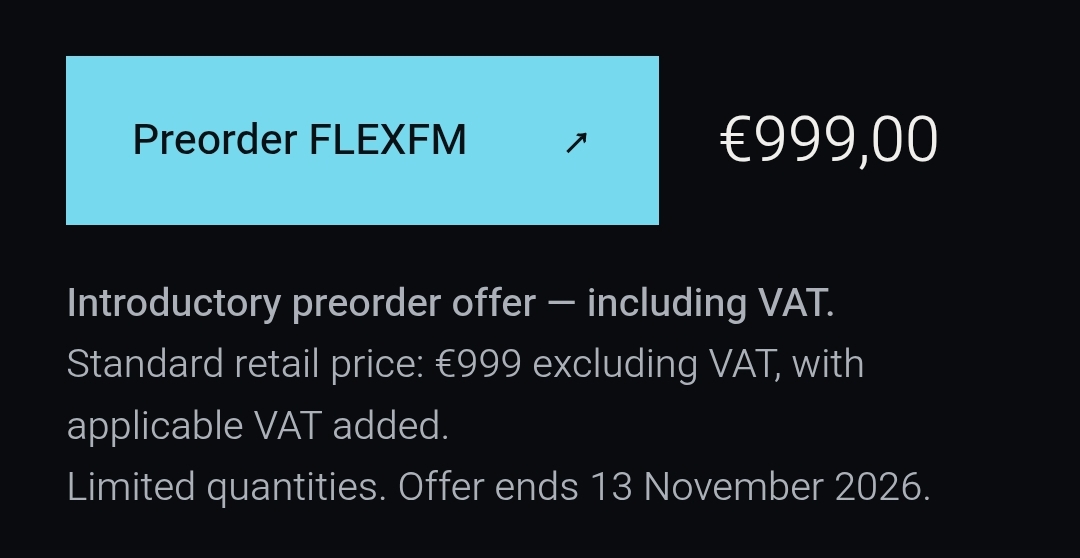
In Spain is 999EUR + 21% VAT so I’ve saved total VAT thanks to the offer and the shipping costs too. I’ve paid 999 EUR in total.
One question because I don’t understand it well in manual.
Can you change the operator in a voice per step?
So for example I load a synth kick and snare in a voice and use only one lane for that…
yep, afaik you can p-lock operator type per step so you could have kick & snare on a single op.
1 Like
Thanks for keeping us updated!
1 Like