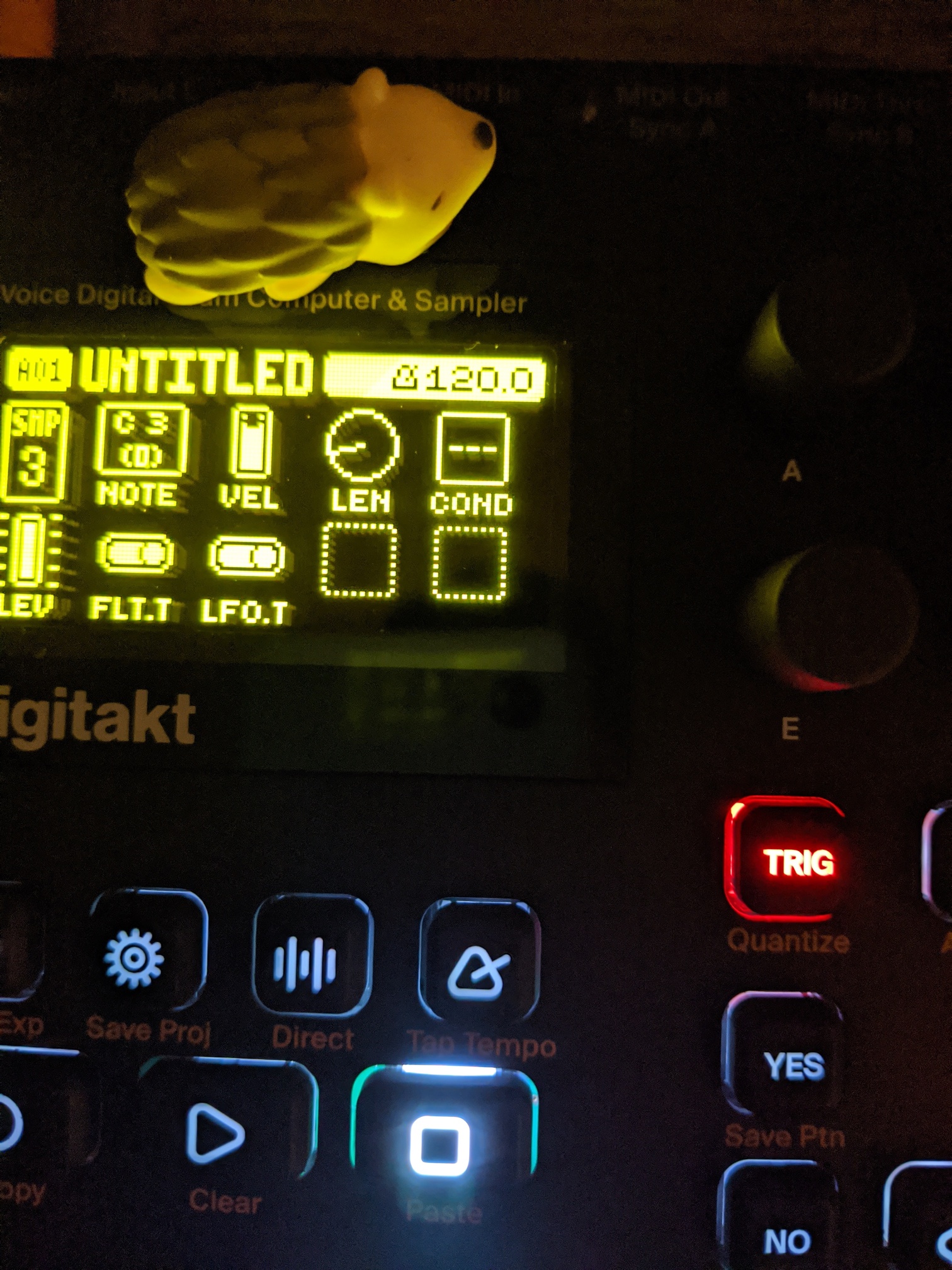
Ok, when I sample into the DT, and leave a bit of silence at the end that I want to trim, it take FOREVER to wind the end point back to trim off the silence. I am turning the knob over and over, and it only moves to the left VERY slowly.
What’s going on? Surely there is a faster way to zoom into the end point of my sample to trim it.
You gotta consult the manual, section 7.2 is where the information is at, it tells all. This is your go-to place for any questions like this, the index is really good and you can click directly on things to jump straight to that section. Not really worth creating a thread for something so basic.
To be fair the manual doesn’t tell you much else beyond which encoders are assigned to what.
Before you rip your hair out on sample length… Don’t worry too much about silence trimming. Just set the length to the desired number of steps and tweak envelope to avoid clipping (if even needed).
I oversample on purpose and typically never trim. Not worth the hassle unless you are sampling different notes/words/sounds in one go for multiple tracks or something. Trig conditions are your friend
EDIT:
However, absolutely use the manual for inspiration/when stuck. Know you won’t know. Save often and try new things. Encoders are typically mapped on the screen or are in relative position to screen elements. Have fun and let loose
Huh? It literally answers OPs question exactly, I think that’s pretty fair. Here is the quote from the manual;
“You can use the DATA ENTRY knobs B and D to zoom in and out to make it easier to see where to trim the sample.”
I don’t think it’s always a good idea to oversample, especially if you’ll be using an LFO on sample start or length while p-locking playback mode, plenty of times when you want your sample to contain only audio and no dead space.
It’s a good idea to read through the manual in its entirety.
That’s why the manual needs to be read while you use the Digitakt, things that aren’t explained in long explicit detail become clear when you try each thing out as you read. I think it’s the best way to get the most out of the manual.
Just tried all these points, and yes, they work fine! Thank you.
@Selfup - Re. Leaving silence at the end of a sample - sometimes when I’m recording myself on the keys, I maybe end up with half a second of silence when I jump back to the DT to stop the recording.
I just figured given the limited (1GB) storage on the DT, it would be good practice to always trim samples. That half second of silence will add up pretty quickly, eating into the storage, yeah?
I mean in theory it should be negligeable but I can see it being a problem if you fill up all banks per project and are near the 64MB of RAM for each project.