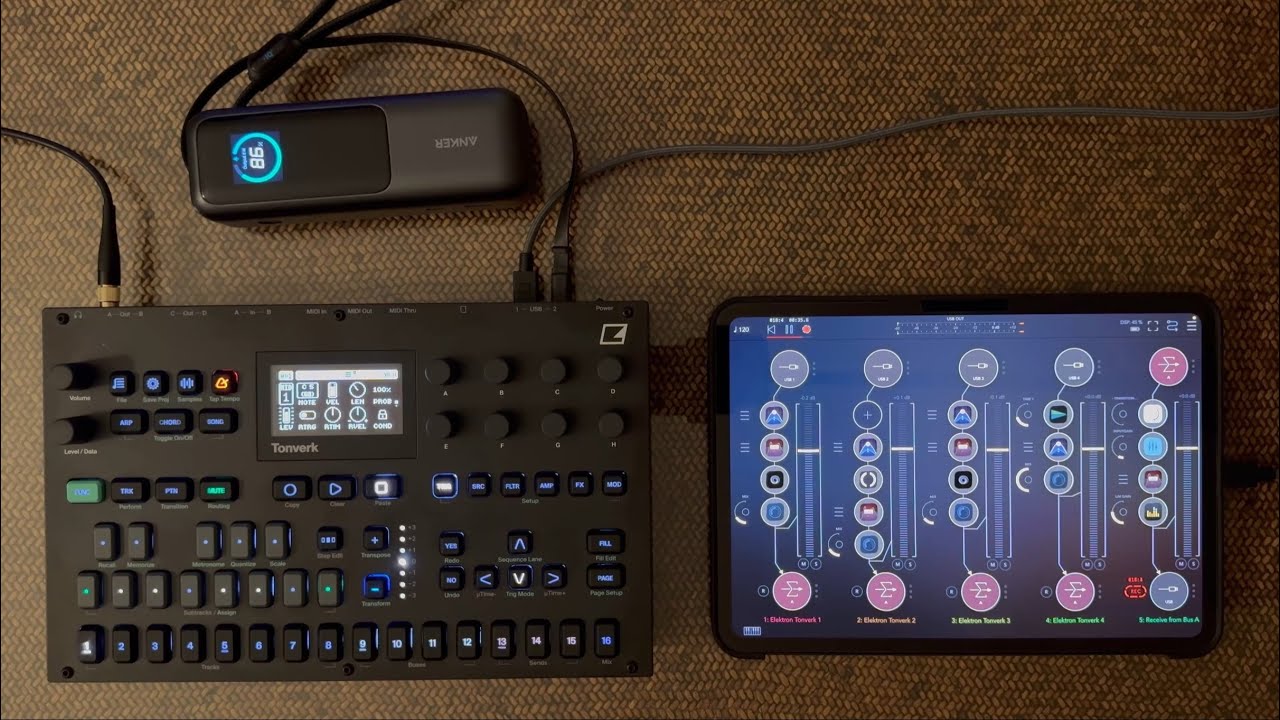
Uff … I really hope Elektron is releasing some Major Updates in the next month. I try to do a performance with the Tonverk but there are so many stupid things happen, that I don’t understand, how this company could release this thing in this state (and I already did the update to 1.0.1).
Maybe it’s my workflow (trying to control “macro” CCs with NI Maschine, using Syntakt FX Block as Insert FX etc.) but I have to say: in all my time with Elektrons since 2014 that’s a really frustrating piece of gear … it’s feeling like a half-baked Elektron simulation right now, sad Sorry for my emotional outburst
So what’s the consensus of the “Tonverk changes sound when compared to Digitakt” or that it does somethig to “samples” ?
I am reading manual and they say this at page 19 (Tonverk manual) - I will point out most important part in my view:
5.2.4 SAMPLES
Tonverk can load and play WAV and AIFF audio files (samples) with 16/24/32-bit depth (floating and fixed point) and a sample rate of 48 kHz (mono and stereo interleaved). Files with other sample rates (44.1 kHz/ 88.2 kHz/96 kHz) can also be loaded, but they will gracefully degrade in quality when played back. You can load up to 4 GB of samples in a project’s internal memory, using a maximum of 1023 sample slots.
Samples are stored on the SD card, and the size and number of those samples are limited only by the available free space on the SD card. For more information, please see “9. PATTERNS, PRESETS, INSTRUMENTS AND SAMPLES” on page 31.
All samples that are played on a track in Tonverk are played back with an attenuation (lowering of volume) of -22dB to maintain headroom in the device. The sample files themselvesare unaffected.
So basically could “lower volume” or different sample rate result in some of you guys reporting that the kicks are not as beefy as in Digitakt? Plus lower volume (also meaning more headroom) could be a factor in overdriving FX and make them sounding different? No?
You can also individually adjust micro timings on each note of a polyphonic step to get strums or loose, more human sounding chords. Very underrated feature
I’m not sure. I did notice the audio waveforms other users posted looked slightly different when coming out of the Tonverk. Maybe @jm2c can provide some input.
Still can’t get it to work. iPad works fine with Roland mk2 and other devices via one cable. I can get audio with one cable using my MacBook Air on the Ton. Support finds IPad sitch strange too - talking with them through it at the moment.
Sort of out of ideas but would love to get it to work for portability.
Appreciate your help/suggestions through this process!
Have you tried using an Apple Original USB-C to USB-A adapter with a USB-C to USB-A cable? Understand that’s not what you want but might work and then we would know that the issue lies somewhere with the iPad connection.
I don’t own one unfortunately. I have tried with my Startech adapter though. If the adapter is powered and then I connect usb A to usb c to the Ton - it works - adapter needs to be powered though.
I couldn’t get my 6th gen iPad mini on ios 26 to work until I added an unpowered hub in the middle. Straight up USB-C connection didn’t work; no sign of the TV from the iPad end.
I returned my TV, so have nothing new to report. It seems to me Tonverk does something to the samples, but no idea what exactly. I did ponder the possiblity that Tv contains some sort of “sampler emulation” in its audio engine, but I’m just speculating at this point, with no concrete facts either way besides undoubtable proof that the samples DO get altered in strange ways… Freq response doesnt seem to change all that much, but RMS levels change quite a bit, hinting at some sort of amplitude-based reconditioning effect
Is there a equivalent of the [func] yes / no in which you can temporary save the current state of your pattern then changes stuff and reload your pattern with [func] no? Can’t find the option…
Edit. Thanks to the manual:
Press [FUNC] + [D1#] to temporarily memorize the active pattern. This is useful for creating a restore point when you are live tweaking, but without permanently saving your changes.
• Press [FUNC] + [C1#] to recall a pattern that was previously temporarily memorized. It will recall the pattern from when you last used the temporary memorize command. If you have not done any temporary memorization, then the pattern will be recalled from the permanently saved state
Not sure how relevant it is now, but a few things that made me return it:
The interaction between a track to a send or bus track is fatiguing. Try this in a low lit environment, you have to know just where the tracks are by sight or through a lot of practice. This takes you completely out of the vibe IMO.
With the different amount of effects that may be on a track, you have to remember what is on what and causing the audio output to sound as it does. You’ll need a lot of muscle memory and to commit to templates. I can’t imagine switching out effects from different tracks in song mode without a lot of cognitive load.
For my style of music, I didn’t particularly like how the effects made anything sound. For my synths, the way it colors the sound is just non-desired. The external pedals I have are way more gratifying sonically
Sub-tracks are pretty much only useful for drums. The accessibility of them makes you just wanna just the affordance of an additional box
Bugs on bugs on bugs. Froze each session, no matter what I was attempting to do with it
Opportunity cost of a Tonverk when the market is pretty much in a golden era of modules, samplers and drum machines, this product really has to be something you’ve always wanted to justify keeping it
Multisampling seems to me like taking a patch in the box and doing stuff with it. Because I didn’t take a liking to the effects, I’d rather pull stems into Ableton and bring whatever I’m working on close to the DAW
Things I liked:
Form factor is well-made and feels incredible
Overall, it seems like a project that was botched that they revived to keep something circulating in the market to satisfy investors. Incomplete, unusable, and niche IMHO.
But maybe when they fix the bugs and add new machines, it could be a sound designer’s dream.
I’ve been struggling getting my ipad pro M4 to detect the Tonverk via USB-C. But I finally got it working both times I’ve tried.
I don’t know exactly what caused it to work, but I just tried various apps and then suddenly one of them discovered it. Don’t remember the first, but the second time it worked when I started Audiobus 3.
Careful with this one for now at least. It crashes my unit every now and then and makes the current project state corrupt. Combined with the project loading with loads of components missing it can really decimate your work.
 Sorry for my emotional outburst