love this, i might get two for different busses on the mixer. would like to hear more of filter sweeps though. watch, now we’ll get a tonverk-platform based drum machine that has global filter after this gets purchased 
3 Likes
It’s available!
I ordered the 2-voice cpm pack with the DS-2, looking forward!
3 Likes
Ordered. Can’t wait, I’ve really been enjoying the DS-2 but with the envelopes it really opens a new world in there. Plus those filters sound sweeeeeeeet.
1 Like
As of today, preorders are open at Perfect Circuit and Moog Audio has stock in. I’m looking forward to it a lot. The DS-2 ended up having a lot of lasting appeal for me as a all-in-one drone system (that can go some other places) so I’ve had this on my list for a while.
1 Like
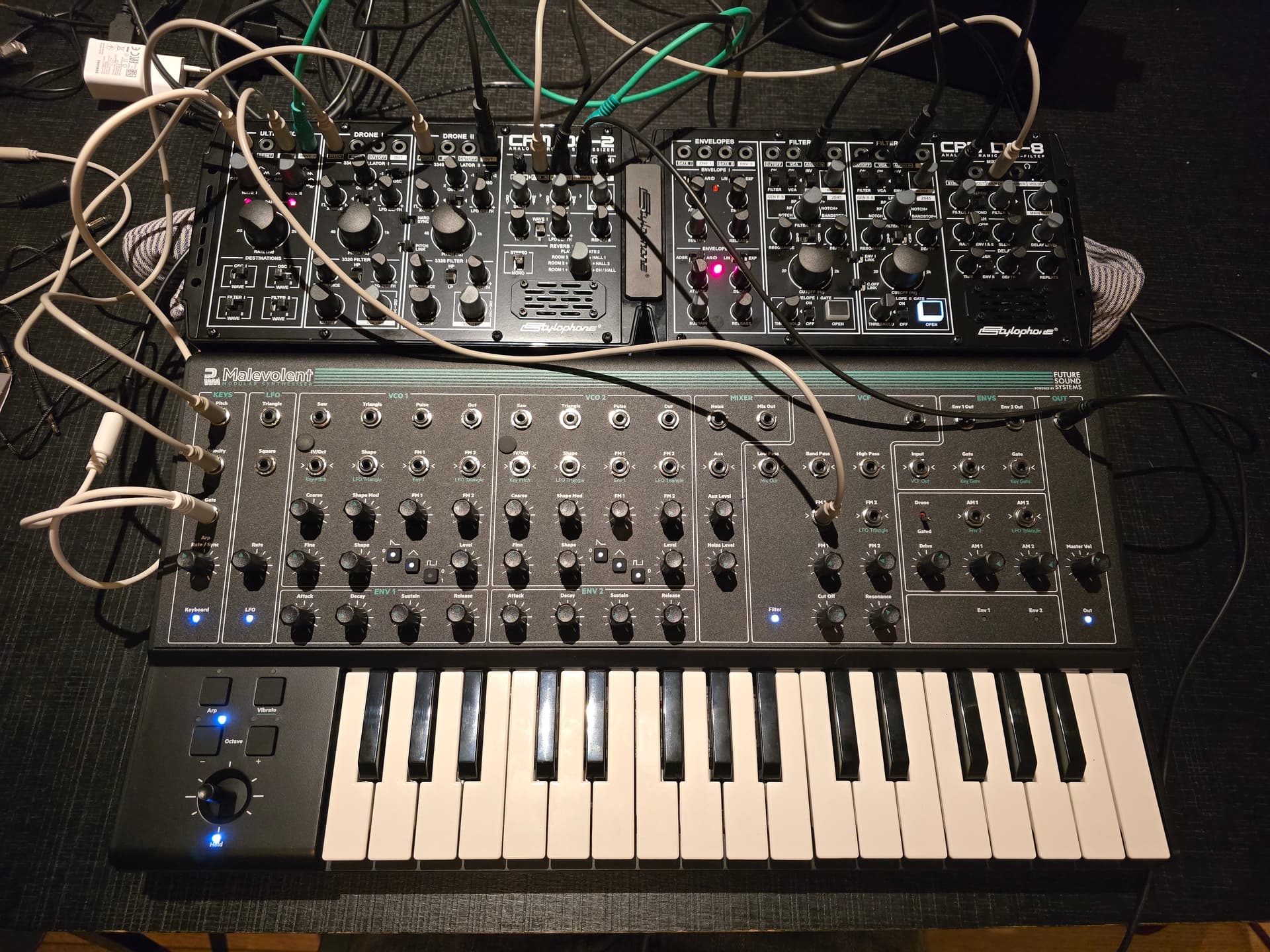
8 Likes
Is it me or is this filter EXTREMELY noisy?
I’ll check again tonight. I used it only in really noisy stuff, so I didn’t really notice. And the malevolent is a lot noisier, no doubt about that.
What I can also tell from pairing it with the malevolent: the genR8 filter is pretty well behaved if you compare it to the malevolent filter 
It’s got character. But the malevolent with the resonance at 5 is breaking up more then the DF8 at full resonance. And that’s without drive. If you want a nasty filter for a very modest price, the malevolent is amazing.
But the 3 of them make for a really nice semi-modular setup. 3 filters in a row is bliss, and the extra envelopes and lfo’s give lot’s of possibilities. I put the audio to the mpc for effects now, next step is pairing it to the CV outs of the MPC for different clock speeds and more LFO and modulation options.
1 Like
If you crank the resonance it definitely can get a little crazy. The DS-2 into the DF-8 and then through DF-8 delay out into DS-2 Delay/Reverb makes some really fun sounds.
At lower resonance levels the 2045 is pretty clean.
2 Likes
Since my review of the Stylophone DS-2 drone synth, I’ve been looking forward to trying its companion in Stylophone’s pro audio range, the DF-8. The DF-8 offers two eight mode filters (hence the name), but it’s more than the sum of its parts. It’s a fun sound source rich in sample fodder on its own, as well as a competent team player in a modular system. I’ll give you a detailed overview of what’s on offer, plus some suggestions, tips and tricks. There will be some audio samples, too, to help you decide what you think. All audio samples are created solely with the DF-8; no post-processing has been applied other than fade in/outs and gain adjustment.
In the interests of disclosure, and because it makes me feel cooler and more professional: I did not receive a review unit (or any other goodies) from Stylophone. I got it for Christmas from my spouse. Thanks, honey!
At first glance, it may be hard to conceive of a standalone filter unit, though there’s precedent for it. Guitar players are well aware of modulation effects (achieved with filters) like tremolo and wah pedals. On the synth side of things, you might recall Waldorf’s now-discontinued 2 Pole, the Vermona Filter Lancet, or the gnarly Sherman Filterbank or Ekdahl Moisturizer. But aside from its use as a standalone filter effect, the DF-8 is also a handy toolbox of utilities that can complement the DS-2 or other semimodular Eurorack-compatible synths.
The DF-8 is housed in the same glossy black plastic case as the DS-2, and has the same power options of 6 AA batteries (which are included with the unit) or a 12V center positive supply. Battery life is good; I didn’t pay close attention but I’d estimate over six hours with the included AAs. The battery option and small size makes the DF-8 uniquely portable among standalone filter units. While I haven’t traveled with the DF-8 yet, I have taken the DS-2 out for jams and on trips a few times, which it has survived quite well.
As with the DS-2 the DF-8 can be mounted in a Eurorack case, taking up 42HP just like its sibling. The overall style of the front panel is clearly labeled and crisply designed like the DS-2. No ‘soft touch’ finish (which can become sticky or gooey over time) is used on the product. Spacing between controls on the panel is good. I do have elegantly-tapered fingers, but I think most people would be able to use the machine without bumping the wrong knobs.
Now that there are multiple units in the Stylophone Pro range, I was also able to test the advertised physical interlock between the sides of the machines. Once you push the ribs into the slots, it’s a secure fit that isn’t too hard to tug apart when necessary. The included plastic tab helps the pair stay together. One does have to take care when moving the units while joined, as they can still come apart. It seems to primarily help them stay put on the table during a dynamic performance.
The system is divided into functional sections. From left to right, you have the envelopes, filters, and output handling. This last bit includes a delay effect and a sample and hold modulator.
Let’s start with the envelopes. There are two envelopes, one for each filter. Envelope 1 is prerouted to Filter 1, and no points for guessing where Envelope 2 is prerouted. Aside from that, both envelopes are the same: You have a choice of ADSR or looping AR and linear or exponential envelope shape. Four knobs set the times for the attack, decay, and release phases of the envelope plus the sustain level. There’s a handy red indicator LED showing the current level of each envelope. The time range for the attack, decay, and release controls varies from a minimum of 2.5 ms to 20 seconds each. In the looping AR mode, this allows for up to a 200 Hz signal. That means that we have an additional audio source within the DF-8 itself if we can spare an envelope. When the looping AR envelope is at audio rate, you will hear it when VCA is enabled in the filter, but it’s a little clearer if you connect the envelope output to the audio input. There’s a little bit of stepping in it as you adjust the attack which feels pleasant, like a descending scale. It is a little hard to perform well but neat.
Next, we have the main attraction, the two eight-mode multi-filters. These come in two categories. Half are derived from Stylophone’s earlier semimodular offering, the GEN R-8, and half from an analog recreation of the SSM 2045, a filter known for its use in E-Mu synths, among others. The GEN R-8 filters include low-pass, high-pass, bandpass, and notch, with a slope of 12dB per octave. The original SSM 2045 featured only a 24 dB/octave low-pass filter, which is duplicated here. The remaining 2045 modes combine this low-pass filter with the GEN R-8 filter. To quote the included instruction sheet (which I can’t seem to find online at the time of this review): “[T]here’s a BP+ mode where [the 2045 low-pass] is coupled with the GEN R-8 HP filter in series with coinciding filter peaks. NOTCH+ mode is also coupled with our proprietary HP filter but this time in parallel and with around two octaves between filter peaks, lastly there’s BANDSTOP+ mode which is as NOTCH+ only with a broader rejection range of around four octaves between filter peaks.” I like both filters. I find myself gravitating more to the gentler slope and grittiness of the GEN R-8 filter, but the cleaner low-pass of the 2045 also sounds great. Of course, it is very subjective.
Each filter has its own I/O section at the top. There are CV inputs for the filter’s cutoff frequency and the VCA’s level. The latter breaks the normalization to the corresponding envelope. There is also an audio input. While not mentioned in the documentation, this is a mono TS input which can accept Eurorack line levels but will work with consumer line level devices, provided that the stereo output is split or summed to mono TS. Also included is an audio output for the filter. Unlike the DS-2, using this output will not break normalization to the unit’s overall output stage.
Immediately below this we have three switches. Two control whether the filter or VCA is currently in use, allowing for greater flexibility. The third inverts the VCA’s envelope. This last one can create some cool effects particularly when the filter’s resonance is up. It could even make a dramatic performance parameter to change live. Finally, there’s a level adjustment for a white noise source. The noise source is mixed with any audio input but will also work on its own, helping you to hear the character of each filter (since white noise contains equal energy at all frequencies) or create new sounds without other audio inputs. You can dial in noise hats, snares and other analog drum machine sounds all your own. A little noise trickled into a PT2399 delay (as included here) with high feedback can create a massive wall of angry sound, too.
The filter has an appropriately chunky cutoff knob with half its travel dedicated to frequencies 200 Hz and below. That low range is handy for creating (via self-resonance) or fattening kick or tom sounds. The unlabeled top of the knob’s range is over 6 KHz according to Stylophone’s specifications. A smaller knob controls the amount of resonance. The filter will self-oscillate at the maximum resonance setting, and you can use the envelope to shape the response to create a variety of cool drum sounds.
A switch allows for a choice of modulation source for the filter cutoff. This can be the sample and hold function (of which more later) or the envelope. There’s an attenuverter to control the influence of either.
The bottommost section controls the gate of the filter’s corresponding envelope. This can be done either manually through pressing a button, or via an optional threshold control. The latter creates a neat envelope follower on incoming audio. The threshold here can be set low enough to allow for lower consumer line level inputs such as phones or cassette players, or higher for Eurorack levels. It’s a great feature to have as a modulation source in its own right, aside from use with the filter or VCA. As for the button, it’s fine for triggering the filter and VCA to sample the output, but maybe a bit sluggish for finger drumming compared to drum pads or Elektron trig buttons if you have a sudden urge to play the kicks and hats you made.
Between the two filters are two switches. One allows use of Envelope 1 to control frequency and VCA for both filters. The other links the cutoff frequency between Filter 1 and 2. As with the DS-2, this linking doesn’t reset Filter 2’s frequency to that of Filter 1; rather, it preserves the ratio between the frequencies as you sweep Filter 1. This way, you can dial in a slight offset between the two to stereo-ize a mono signal, or introduce a more radical change for creative effects.
The right-hand side of the DF-8 is roughly divided into the mixer, sample and hold, and delay functions. The mixer has level controls for each filter, plus a stereo/mono selector switch. When stereo mode is engaged, filter 1 is hard-panned to the left channel and filter 2 to the right. This allows for using the whole unit as a stereo filter with independent motion per channel, which can add a bit of stereo sheen to an incoming mono signal. We also have a line out level control with corresponding output jack above.
Next comes the sample and hold section. During my early semimodular days, I misunderstood sample and hold as being a stepped random LFO rather than a CV source which periodically samples a given input and holds the current voltage value until the next sample interval. However, the DF-8 offers a choice (via switch) of noise as the source of samples or envelopes 1 & 2. The documentation sheet suggests here that “macrotonal and microtonal patterns and sequences can be created” and the envelope 1 & 2 option does yield an orderly repeating pattern of tones. There is a slew control to blend the output from discrete steps towards a smoother random waveform, and a rate control. This last is the only part of the DF-8 regulated by the sync input (which takes a 2 PPQN signal). Using sync, the S&H rate matches the incoming tempo when the knob is at noon, with five divisions to the right or left which respectively double or halve the rate. A red LED is handy for monitoring the rate (and checking if you actually got sync to work). Without sync, the rate can range from 0.125 Hz to 128 Hz. Particularly with slew enabled you can get some nice slow modulation for your DS-2 drone, or a strange-but-good audio signal at the highest rates. Here’s a sample of some bubbly resonant audio rate sample and hold with sample and hold controlled resonant bandpass added.
Almost at the bottom, we have the controls for the delay effect. This is a PT2399 delay, well-known by now as the chip behind the Korg Monotron Delay, the Make Noise Strega, and countless boutique guitar effects. As you probably know, it’s a noisy delay, especially at longer times and higher feedback levels. By my measurement, the minimum delay time is 60ms, and the maximum is around 500ms. The delay time can be modulated with a choice (via switch) of the sample and hold or Envelope 2, with an attenuverter to control the depth of modulation. In my experience the last ten percent or so of the feedback knob will get you into that self-oscillating, barely controllable range that makes the Monotron Delay what it is. The level control for the delay, which lives just above in the sample and hold section, blends a mono delay signal into the output. The input to the delay is controlled by the levels of filter 1 and 2 set in the mixer section, so a 100% wet delayed signal isn’t available.
Finally, there is a speaker, which is fine for what it is and a bit nicer than Korg Volca speakers if you’ve had your ears bent by one recently. I would not count on it for studio-accurate monitoring. Plugging in headphones disables the speaker entirely, possibly to the relief of others in your immediate area.
When I first received the machine, I knew it’d be handy to have a VCA and some additional utilities for the DS-2. I was more curious about whether the DF-8 would be fun to play with on its own. It ended up becoming a neat challenge to figure out how much I could get it to do without adding anything else. I managed to stir up some simple beats by using the white noise and self-resonance in the filter sections along with looping AR envelopes.
If you bring in the sample and hold as a source of random pitches, you can make a nice “Krell” patch (inspired by the work of Louis and Bebe Barron on the Forbidden Planet soundtrack) that suits the PT2399 delay well, especially if you modulate the delay time and play the cutoff knob a bit. Here’s a thrown-together little Krell as an example.
Since it is a relatively simple device with few patch inputs, it seems to invite you to make the most of exploring every possibility for modulation and sources of audio. It is as performable as the DS-2, and the two units make a great fit together, especially if you enjoy making drones as much as I do. I’ve already recorded a drone album with the DS-2 and the DF-8 which I hope to release very soon.
Looking across the whole Stylophone pro range, Dubreq are doing some really interesting things at a price point which is very accessible. This is affordable, approachable synth hardware that can be taken seriously, a semimodular take on the Volca concept of portable, even cute, gear at a low price.
So, I like it quite a lot overall. The question is, will you? If you have the DS-2 already, it’s a natural pairing, and adding the just-announced Stylophone OTF sequencer will give you even further options while keeping things in the family. (And, if you can’t wait, the Korg SQ-1 is a standby for a reason.) If you’re looking at this as your entry to the range or simply as a standalone filter, I think it can add a lot to your existing semimodular synths for the price. If you have a Eurorack system already, you will have a lot of choices for filters, stereo or otherwise, and you’ll want to decide based on what sounds best to you. That’s not always easy without trying them in your own studio environment. The DF-8 does offer a unique filter that you’re unlikely to have (unless you’re the lucky owner of a GEN R-8) with a few handy utilities to sweeten the deal. As the MW folks are likely to say, you can never have too many VCAs! I would also recommend the DF-8 if you have a sampler and would like to make your own unique drum sounds, or filter and resample other content. I got some really nice tones out of it that I want to use on some new tracks once I finish writing this 200 page review. It’s deceptively simple, but addictive.
13 Likes