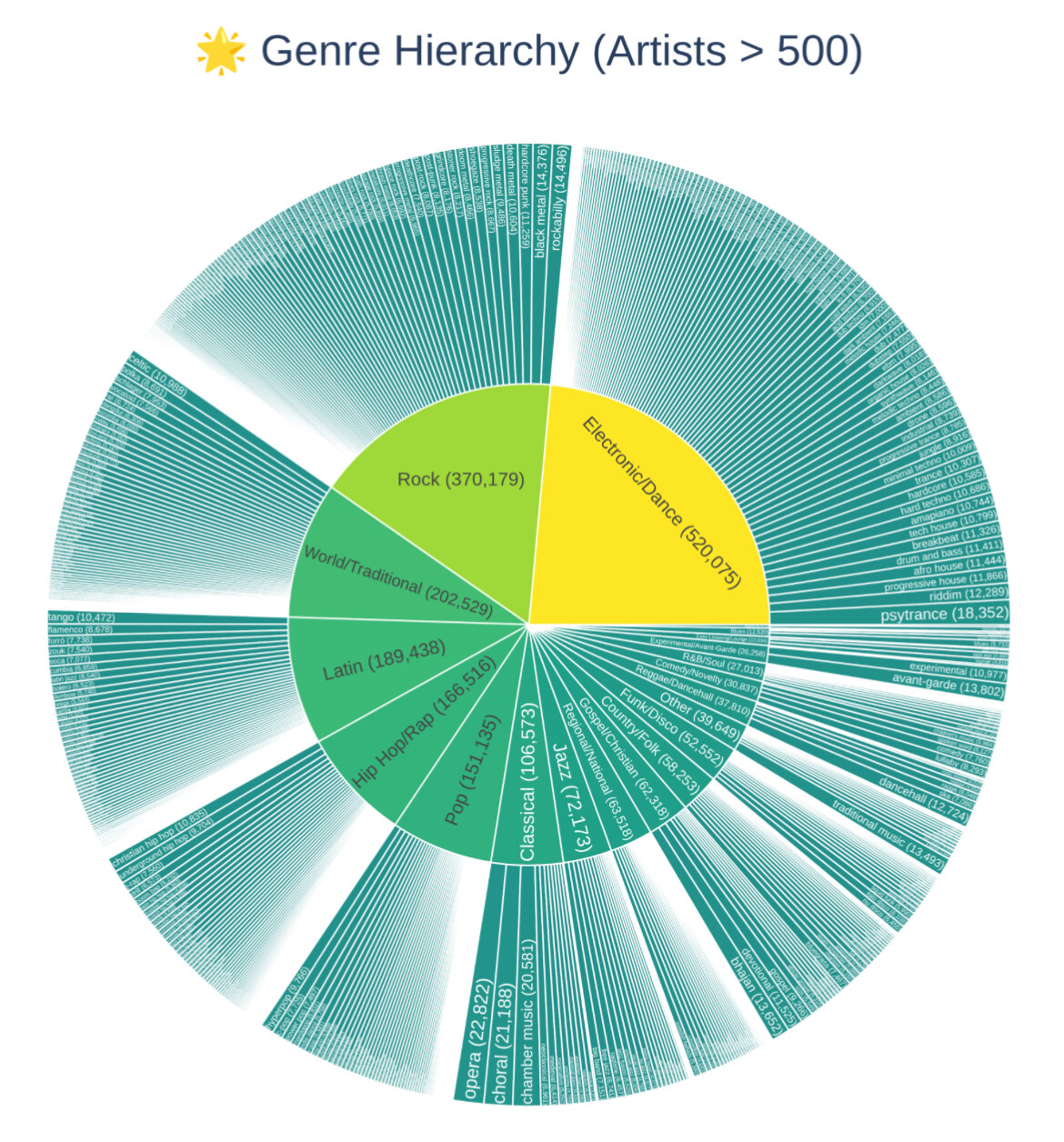
I believe that this is because many of spotify’s higher tier listeners are actually businesses, like restaurants and shops etc.
They use that type of low volume easy to ignore music in the background 24 hours a day leading to repetition so more artists in those genres kinda makes sense because more playlists equals more variety.
I would also guess that maybe the artists or “title holders” themselves for that type of music don’t have a wide range of options to make money outside of performing live, but for the last you know 65 years or whatever, modern music has dominated the charts and over the counter sales probably reflect that.
Digital and streaming gives access to customers but making the connection is difficult because are you going to make a bandcamp or youtube? Maybe you might employ a multi platform approach but spotify has so many listeners and the aforementioned playlists that maybe that’s just what’s profitable.
Also maybe it reflects that a lot of classically trained “degree holding” musicians focused their studies in those areas and the people most concerned with making money from music will be those for whom it is their sole source of income.
Perhaps as a sheer numbers game, the statistics just meet at spotify for certain genres due to that being the only real option, or for them perhaps a step that they can’t skip whereas other genres you can build a fanbase around youtube or bandcamp or soundcloud.
I don’t have the numbers for any other sites but I would bet that any of them which have the same type of background music playlists and paying customers will show that there is some presence from these not modern genres which might be more useful commercially than personally.
Maybe there are also a lot more well-aged spotify listeners than one might suspect, and unless we can see spotify age demographics to tell us who the listeners are and where, there is nothing we can really extract besides supposition, however I think that there are a few potential explanations and it’s just whether or not they can be proven is all.
It’s not for employees, it’s background music for customers at restaurants and spas and in hotel lobbies and shit.
You ignore it by design but it’s there. I bet the only place you can get played in an operatic genre is on streaming services. Radio is pretty much dead and there are only so many concerts.
They may be more motivated because there are less options, that’s all I can say.
Operatic music as a genre might be tagged pretty liberally on spotify as well, which is why choral music is right up there with it. People just trying to cover more genres.
It’s not all going to be pavarotti, who may still be considered the most popular singer in the world.
Numbers don’t lie, it’s just interpreting them which is tricky.
Surprised no one’s said it, but I think the opera thing is due to grouping.
The same reason everyone calls symphonic music (or whatever it’s actually called, I’m sure someone on here will correct me) “Classical Music.”
If you add up the numbers from a bunch of the contemporary microgenres into something as generic as “opera” (like say “metal” or “heavy rock” or “electronic music”), it gets knocked way down the list, basically to the bottom.
It’s like they’re doing musician gerrymandering, the way they split those genres. It’s what 538 would’ve called a “bad use of data.”
Per track x genre not being available, per artist x genre is what they used. In the absolute, it does not shock me that (certainly often professional) classical performers are leading the numbers in this table.
Also, how is it that this list has “underground hi hop” and “christian hip hop” but not, y’know, “hip hop.”
You’re telling me that there are less than 9,704 hip hop artists on all of Spotify who are neither “christian hip hop” or “underground hip hop” ?
Edit: Given the inputs, the his data seems way more helpful at seeing which genres are the most atomized into microgenres than how many actual artists there are in each one.
Exactly, that’s the point, there’s a solo violinist, then an opera singer, then maybe in tandem, or in cooperation with an orchestra, etc. The other point is genre, which in this case seems to be very specific rather than big categories.
I wonder how good or bad Spotify is at identifying multiple artists on the same track. Seems like that’s always been a fatal flaw in digitized music, going back to the p2p days or even before.
btw how come no one is surprised by the number of psychedelic trance artists? Supposedly the number one electronic music subgenre in terms of artists count.
my guess is the top categories are also the most easily produced by AI and presented to audiences that will consume it, as shig was saying in stores, restaurants, as well as just generic bigass playlists. you know theres trad caths who are just searching “jesus” or “worship” on spotify and playing whatever playlist pops up first on nonstop repeat. i know of at least two different old people who would love playlists of “new” opera
It’s what @KingDuppy said. Its because of how they categorized the subgenres. There is progressive house, afro house and tech house near the top. Collectively more than psytrance if you group them as house. But they don’t seem to have darkpsy or forrest (he said revealing too much knowledge of psytrance sub genres… maybe I do have an addiction @klaustrophil) which means psytrance is the biggest of their definition of subgenres. And that psytrance is awesome