I have a PreenFM3 which has been dormant as I was distracted by other things. I guess the most annoying thing was the screen going blank, which is hopefully a software issue, not hardware. My interest is renewed as I just got a JellyMix and the PreenFM3 has multiple outs. Seems like there’s new firmware? A fork? Which version should I install? It’s on 1.03. Thanks.
1.03 is the latest official version.
Toltekradiation (who contributed to the official firmware) has been working on a web editor. In the process of making some changes to support the editor, they also reworked some of the FX (which I think they wrote originally?) That all currently lives in its own space here under the version “1.06” — but I wouldn’t be surprised to see it merged into the official release at some point.
1 Like
Thanks. I think I’d like to try 1.06, but I’m a bit unclear from the instructions whether I can upgrade on Mac without opening the case to access the SD Card. My unit doesn’t have an external SD card slot.
Hi all. I just acquired a PreenFM3.
There are not a lot of presets on this unit for me to noodle on. The ones on it sound a little unlike what I was expecting… not amazing, so I just wanted to check some other banks out to see if there is a difference.
I was led to the ixox forum, as apparently the only place you get patches from (According to chatgpt anyway)? I cannot access the forum as my request is still under approval for some days. I think the owner has to manually let me in. I’m not even sure its currently active.
Anyways, does anyone have any links to other places I can look for patches/banks for the PreenFM3? I’d really appreciate some leads. I’m looking for Preen specific patches, not DX7 compatible ones.
Thanks so much!
Best wishes.
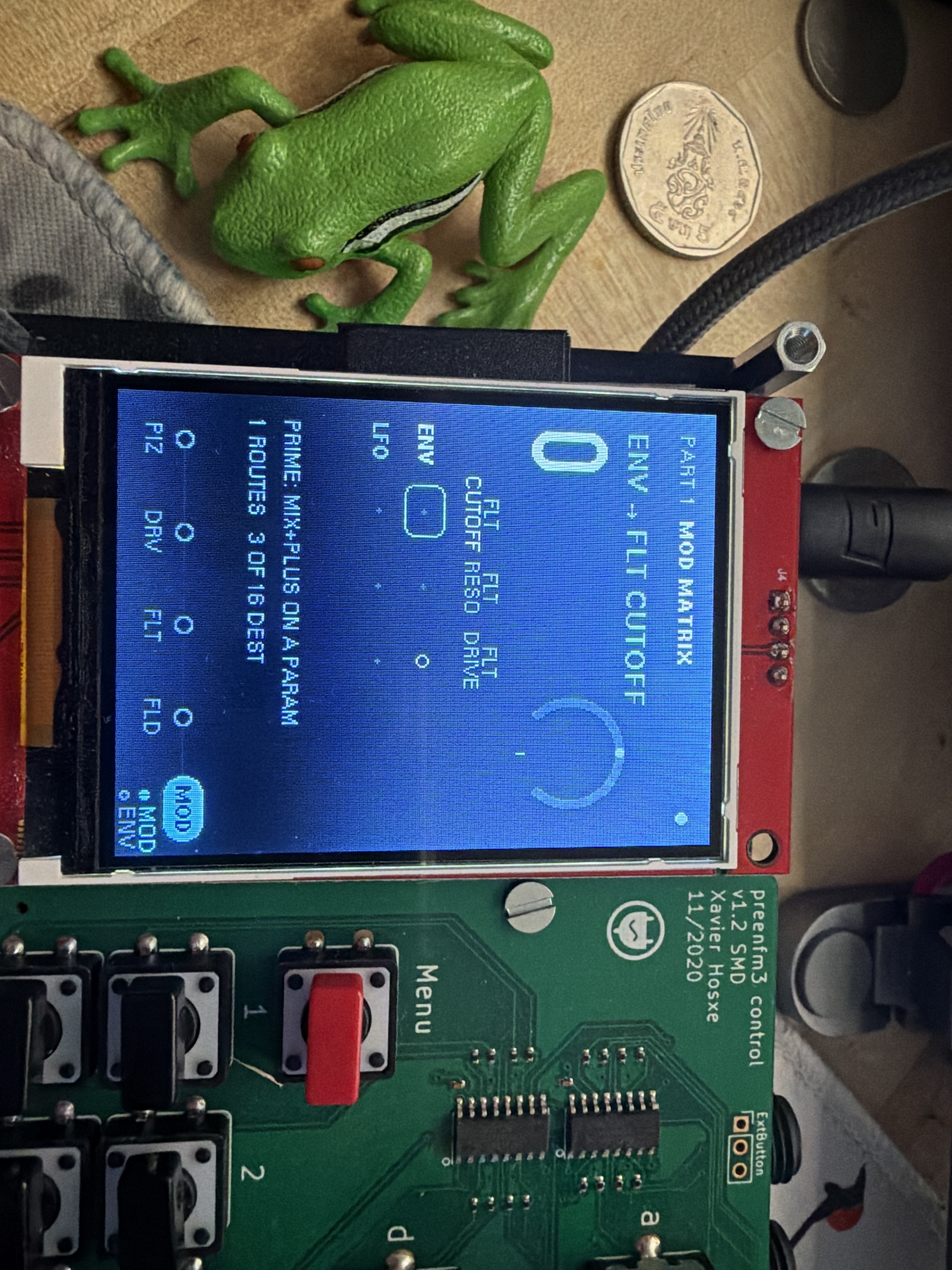
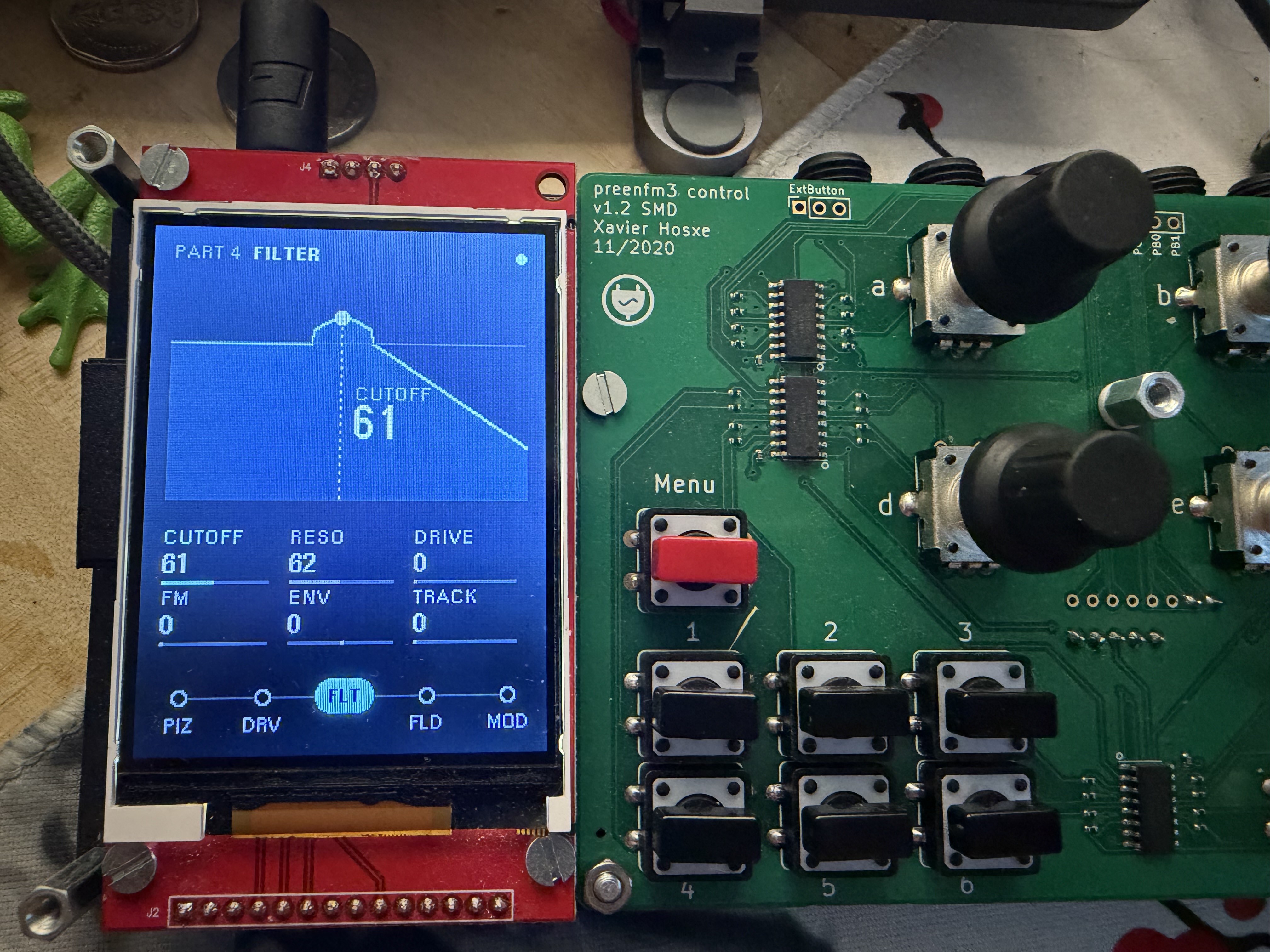
So, the big reason I rewrote the PreenFM3 firmware from scratch: I found it really hard to program. The hardware is seriously capable, an STM32H7 at 480 MHz with three stereo outputs, and I wanted an instrument that makes it easy to get at all of that.
It’s called Chimera, written from the ground up in Rust. (I just finished a rewrite of the Ambika firmware thats a similar idea. the Chimera, hoefully, is that idea taken to its natural conclusion)
One synth, several engines. Six Parts, each running its own engine:
- An FM engine (6 - OPs) built around morphing. Every patch holds two algorithms, taken from the TX81Z’s eight plus 24 more, and MORPH blends between them, fading connections in and out while you play. The operators have a TX81Z feel: rate-based envelopes, feedback on every operator, and alias-free TX waveforms.
- A physical-modelling engine with plucked, bowed and struck strings and resonators.
- A virtual-analog engine, coming next.
Patched like a semi-modular. Nothing is hard-wired:
- Three envelopes, three LFOs, velocity and note run through a mod matrix into cutoff, VCA, fold, pitch, MORPH and more.
- To make a route, hold MIX and press PLUS on any knob.
- The envelopes are modelled on Intellijel’s Cascadia: a full AHDSR, or a function generator that works as an envelope, an LFO or bursts.
You can see what it’s doing. The screen shows the living FM algorithm, the envelope’s shape, the filter’s response, and every route in the matrix with its amount.
Effects with character. A dark, Quadraverb-flavoured reverb, chorus, a tape delay, a tape stage and a master compressor.
Up to 8 voices. Each voice’s CPU cost is measured on the chip, so it never runs out of processing mid-note.
Huge thanks to Xavier Hosxe, who designed the PreenFM3 and open-sourced its firmware. Chimera runs on his hardware and boots through his bootloader, so you can always flash back to the original.
Any weird feature requests, or features from the previous firmware that are an absolute must… drop them below.
10 Likes
Have a preen fm 2 … but know someone with a preen fm 3 so will pass on
Hell yeah, this is amazing. I have a Preen FM3. What an exciting project!!! 

1 Like
If I recall the hardware is still hard to come by? I have a FM2 and really like it but wouldn’t say no to an FM3.
Regarding availability, on the original shop page (PreenFM Shop) the following reason is mentioned:
cs4344 (preenfm DAC) are End Of Life by Cirrus logic.
Preenfm2 and preenfm3 are out of stock and
cannot be built without the CS4344.Modifying them to work with another DAC is not easy,
and i don’t have any plan to do that.
1 Like
https://reverb.com/item/101274900-ixox-preenfm3-2026-black-blue
^ you can still find them on reverb.
supposed drop in replacement for the above part.
2 Likes
Hat means that original design should be updated for PCB production if pinout fits seamlessly. Possibly a PreenFM4 with your firmware?
I’m not an Electrical Engineer so I’m unsure.
So I recorded a bunch of samples to give everyone an idea of what the character of the synth will be. i put this in this Claude artifact for quick hosting.
Audio Demos here → https://claude.ai/artifact/G51SPxuqy244XQX1vmvkg5
6 Likes
Yoink. That’s mine now.
So you created a completely different firmware with different architecture and features, correct?
That implies won’t load any of the old sounds, and it won’t import Yamaha DX patches.
Which of the TX81z’s algorithms did you implement?
And are the effects global, or per part?
1 Like
So you created a completely different firmware with different architecture and features, correct?
Yes, it’s a ground-up rewrite in Rust. It’s multitimbral, with 6 Parts, and each Part picks its own engine:
- ALGO: 6-operator FM.
- MODAL: a resonator/physical-modelling engine in the Elements/Rings family (Not a prot though! it can sound like MI Rings or the Korg Volca Drum).
- More engines are on the way (Virtual Analogue, a drum synth, and a Oscillator design I have round a tape machine. ).
It also has a generative polyrhythmic sequencer called ORBIT. The hardware is the same PreenFM3; only the software changed.
▎ That implies it won’t load any of the old sounds, and it won’t import Yamaha DX patches.
Right now, no. The patch format is new. A patch importer for DX7, TX81Z and PreenFM3 sounds is planned, though. The goal is to bring old sounds across, not to drop them. Another difference: ALGO uses phase modulation, the same as the DX/TX hardware, while the stock PreenFM3 does true FM. So imports will sound close but not identical.
▎ Which of the TX81Z’s algorithms did you implement?
All 8. They’re the first eight algorithms (T1 to T8). Each one runs the TX81Z’s 4-operator routing on operators 1 to 4, with a spare 6→5 pair on top. After those come 24 more six-operator layouts, for 32 in total. You can also morph between two algorithms.
And are the effects global, or per part?
Both:
- Per Part: drive wave folding and filter sit in each Part’s own chain.
- Global: chorus, delay and reverb live on a shared FX bus, and each Part has its own send levels into it. the FX bus feeds into a Master compressor.
- Routing: the delay can feed the reverb.
3 Likes
So, every Part in the Chimera firmware is a chain of modules (semi-modular style). You walk the chain left to right on the screen, and each module has its own page. A Part chooses its engine, and the engine sets the front of the chain. Everything after the engine is shared.
The current state of the Firmware, today.
ALGO (FM)
ALG → OSC → DRV → FLT → AMP → MOD
- ALG: picks the operator routing. There are 32 algorithms: the TX81Z’s 8 (4-op routings, with a spare operator pair) and 24 more 6-op layouts. You can morph between two algorithms, so a sound can move from one routing to another. Its sub-page is PITCH.
- OSC: the six operators. Each has a waveform (the TX81Z’s W1–W8 plus TRI, SAW, SQR and pulse shapes (FSR1 formants are planned.)), coarse and fine ratio, detune, level, velocity, a 5-stage TX-style envelope (AR · D1R · D1L · D2R · RR), rate scaling and feedback.
- DRV: drive, or saturation, after the operators.
- FLT: a state-variable filter with LP6, LP12, LP24, BP12, BP24, HP24, NOTCH and PHASER (PHASER is a WIP) modes.
- AMP: a wavefolder into the VCA.
- MOD: a modulation matrix with 3 envelopes, 3 LFOs, velocity and note number as sources, aimed at the chain’s parameters.
MODAL (physical modelling, in the Mutable Instruments Elements and Rings family)
EXC → RES → FLT → AMP → MOD
- EXC: the exciter, meaning how the “object” is set going: PLUCK, STRIKE or BOW.
- RES: the resonator, meaning what rings: STRING, BANK (a modal bank, like a bar or bell), BOWED, or SYMP (a string with sympathetic strings ringing around it). Its sub-pages are a second resonator page and PITCH. Notes keep ringing after release, as on Rings.
- FLT, AMP, MOD: the same modules as ALGO.
After the chain: the mixer (per Part)
PART → SENDS → CHORUS → DELAY → REVERB → MASTER
-
Per Part: level and pan, an output pair (three stereo outs), and send levels into the effects.
-
Shared FX bus:
- a Juno-style BBD stereo chorus (I, II, I+II);
- a tape delay with wow, flutter, saturation and high rolloff;
- a reverb modelled on the Alesis Quadraverb’s ring of loops.
The delay can feed the reverb.
-
MASTER: a compressor linked across all three outputs, then a trim and a peak limiter on each pair.
How it differs from the stock PreenFM3 firmware
- More than one engine: FM is one choice. A Part can be a physical model instead, and more engines are coming.
- Phase modulation: ALGO uses PM like the DX7 and TX81Z, where stock uses true FM. It also adds algorithm morphing.
- Navigation: you move through the chain module by module, one page per module, instead of through a parameter menu.
- Mixing: each Part has its own output and effect sends into one bus, and the master runs on all three outputs.
4 Likes

Oh man, such great stuff. Keep doing your fantastic work!
1 Like