Oh, interesting.
Switch off Warble. It introduces a small latency to get the slowing down effect.
If you want to use it nonetheless, make sure the Mix in Warble Settings is full wet!
Note: the Mix Potentiometer on the front is for the Heat part and doesn’t introduce this phasing effect.
You don’t need AH mix setting to be full wet - parallel processing is one of the AH’s key features if desired. I’ve got the Mk2 and I love it, it’s the only Elektron piece I have right now.
I’ve got the MK1, it’s a +FX feature iirc? This is so weird oh well, I’ll report back if I figure it out later this week for anyone running into this issue in the future. Cheers for the suggestions!
Your mixer is digital?
I’m guessing this is were the latency issue arises.
Try the prefade send option mentioned above, if you can and turn down the original track fader.
Hey mate! Thanks for checking in. Yes, it’s a digital mixer. I wasn’t able to sort it out unfortunately, so now I’ve got it routed to the main out. It’s not too shabby. Might give it a go next weekend if you have ideas!
The issue is with the digital mixer. The extra DA/AD loop adds latency which causes the comb filtering effect. Do digital mixers have a delay compensation option? That would delay everything a few samples so that the conversion loop aligns with the internal signals.
Someone was saying the physical signal path in the analog realm could cause this, but that’s incredibly unlikely. The delay would be the length of the signal path divided by the speed of light.
Even on an analog mixer the wet/dry blend isn’t that useful unless you decide to not use the filter. The filter creates a frequency dependent phase shift as it approaches the cutoff frequency so you still get phasing (like an analog phaser effect)
It shouldn’t be latency as the signal should be sent 100% wet so there’s nothing for it to be phasing with. I would have thought it more likely that this is a routing issue, the Allen & Heath CQ-20B does not look like the most straightforward mixer to integrate with external FX hardware. If @ex wants to solve it then I think we’ll need some images of how it’s physically routed
I suspect that the point here is that even a 100 % aux signal with a significant delay (because of multiple ADC/DAC in the signal path) will cause phasing issue, no? Especially since saturated signals are closer to the original signal than more creative effects.
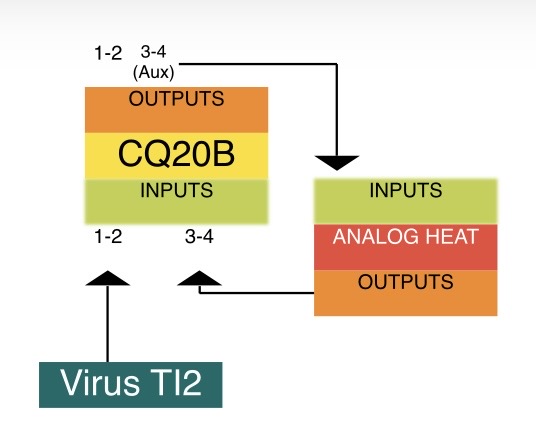
This is how it’s routed, sorry about the horrible graphics I’m no technician, so feel free to let me know if something is wrong.
You will only get phasing if you have two signals in parallel (slightly offset), and to use the Analog Heat you want one signal - it goes in, it comes out. There should be no other signal to phase with.
On the CQ-20B mixer I’m not clear how it works, sorry, had a look at the manual but I’m not clear. It isn’t set up for external send/returns and it’s difficult to understand without having a unit in front of me. But essentially you want to send the relevant channel (eg Virus) out to the AH, return the AH into the CQ-20, and make sure the original Virus channel does not go to the main LR outputs. This is like an insert, or a pre-fade send.
[edit] - Allen & Heath will no doubt be able to sort this for you of you drop them an email.
Yeah I get what you mean, it’s just that this wasn’t obvious to me before. I thought using send&returns for parallel saturation was a perfectly viable thing to do
I’d like to switch between projects often, so I’ll see if can make these mixer volume adjustments tied to NRPN values per pattern or something.
Parallel saturation is perfectly viable (and a good idea) but you must do it on the Analog Heat itself with the wet/dry knob! That way you won’t get phasing.
Yeah, I’m just disappointed because that means I gotta get a saturator per track to beef up the whole mix properly. Kind of defeats the whole purpose of my compact rig.
But I’m using it as a master effect now, which I actually am enjoying for mix and jam purposes
no it doesn’t. @tedmanzie’s solution should work fine for parallel saturation and it won’t phase if your original channels are only sending to the saturator and not outputting sound on their own.
does your mixer have groups? if so you could put the saturator on a stereo group and route your channels to that instead.
this problem is simply a result of the latency incurred by AD/DA conversion. if your mixer and saturator device would be all-analog then there would be close to 0 latency and phasing, so you wouldn’t be forced to work around it by sending pre-fader and muting the original channel to avoid the phasing. not familiar with your mixer but if it can do latency compensation then that should solve your issue too.
Interesting, cheers for the effort explaining this to a technical analphabet. Does DCA count as a group? It has those. If this works I might actually be able to revive the CC controlled aux saturation idea if I can get my hands on a Bomebox to send NRPN to the mixer. Thanks!
 oh well, I’ll report back if I figure it out later this week for anyone running into this issue in the future. Cheers for the suggestions!
 I’m no technician, so feel free to let me know if something is wrong.