Yeah both also have workarounds to do some of the same things by different ways. Of course some things remain exclusive to each though.
You cannot freely freely delete, copy or or insert bars on the OT. Elektron sequencers do allow copying and pasting of bars, which is not quite the same.
On the MPC you can insert a bar anywhere in the sequence and if you delete a bar anywhere in the sequence you are not left with an empty bar.
All elektron sequencers have a fixed grid size of 16ths, hence people have created tables showing how to use micro-timing to obtain triplets.
You can adopt akward work arounds to obtain different time signatures on Elektron sequencers, hardly supportive. The MPC lets allows you to simply set what time signature you want to use.
The OT can resample and it does not have audio tracks.
2 Likes
I guess we have to agree to disagree then  Workarounds are not the same as something being impossible. Using the arranger on OT can easily do copy/paste/insert, and you can do it in patterns too.
OT has upto 8 audio tracks.
1 Like
Yes 20, or multiples of, is correct for 5/4 (my error in earlier response).
You can chain different length sequences on the MPC One.
However, the most common use in music is to simply have the same time signature throughout a song.
The MPC easily supports different time signatures whereas Elektron sequencers are inherently 4/4 and the main reason for this is because they have 16 hardware trig buttons.
Hardware sequencers which support different time signatures (commonly found in workstation sequencers) generally don’t have dedicated trig buttons.
1 Like
The old Roland tr and mc boxes have different time signatures with dedicated trig buttons, but implemented in a different way.
Personally I like the way the octatrack handles time signatures as opposed to the Mpc.
Mostly because while jamming I dont know the time signature beforehand and on the mpc it is not possible without a workaround to change it afterwards. I always have to start a new project or insert and delete bars.
Octatrack for me is more flexible that way.
How do you insert a bar using the OT’s arranger?
Ok so say you have pattern 1 which is 4 bars, then pattern 2 which is a different 4 bar pattern, now lets say you want first 3 bars to play pattern 1 and 4th bar to play pattern 2, insert pattern 1 into row1 of arranger, set len to 48 and offset to 0, insert pattern 2 into row 2 of arranger, set offset to 48.
5 Likes
If you are talking about the three sets of lines above Roland trig buttons, they are still used on modern Roland equipment (e.g. JD-Xi).
But they are not for different time signatures, they are just a guide for the possible different trig lengths - 16ths, 32nds and 16th triplets.
1 Like
I love both my OT and MPC for very different reasons. But the sequencer is NOT one of them on the MPC. For the life of me a I can’t make a track an odd number of steps (not beats) long. Also, I haven’t figured out how to do trig conditions on the MPC.
I’m ok with those limitations because that’s just not what the MPC does. Those limitations encourage me to make a different kind of music on the MPC than say, the OT.
Talk about limited, try the Pioneer SP-16. But again, probably the fastest box to make a jam with because of its limitations.
I don’t know. They’re all different. Embrace the shortcomings and make music.
Thank you for this. Very helpful. I will be taking delivery of an OT today, and had considered trading in my MPC One to get it, but then decided to keep the MPC and see if I can figure out a way to use it, the OT, an A4 and M:S together for some kind of workflow for song composition. I find “making beats” by itself pretty boring, but have found ways already to use the MPC for much more than that. I am hoping to do sampling back and forth between the MPC and OT, but think I will need a lot of time to figure out how that will work for me.
1 Like
The OT’s arranger lets you playback pre-created patterns, or sections of said patterns, in a particular sequence.
If I want to do that on the MPC, I would use either song mode or next sequence mode, and yes I may have to copy sequences and delete bars to achieve the wanted arrangement.
However, if say I had just created a 4 bar intro and then decided I would like the first bar to play twice but maybe an octave higher, I would use the insert bars tool. The OT does not have an insert bars tool (or it didn’t have when I owned one).
I have no problem liking both the Elektron and the MPC sequencer and I can fully understand why a person would prefer one over the other.
I have been using hardware sequencers for well over 30 years, starting with a Yamaha QX7, and the MPC one is the first MPC I have ever owned. In general, it is undoubtedly a more powerful sequencer than the OT. But, that does not mean it is better because better is subjective to personal requirements.
3 Likes

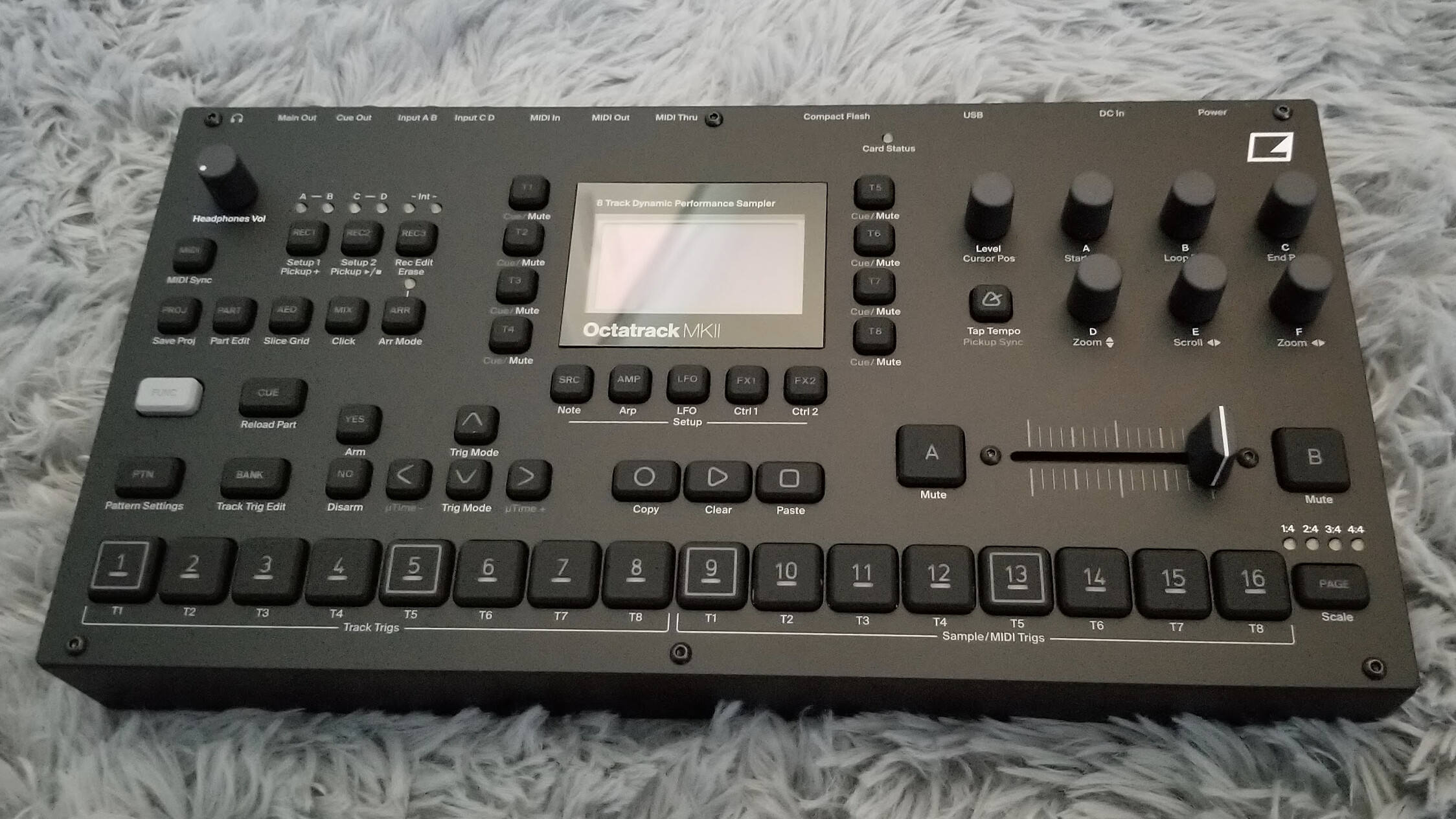
Regarding MPC One or Live 2, the devices look great and seem solid to me.
That said, one thing that did start to turn me off to it was the cookie cutter style to beat making in many of the YT demos. Basically triggering a sample, and then stuttering it over a drum loop. This wasn’t about the style of music, as I enjoy all music, and more about the approach. I think this really undersells the capabilities of the MPC devices.
By contrast the videos on the OT showed a lot more creative diversity IMO.
Now I know we’re on an Elektron forum, so it’s not like this conversation is going to be fair 
Still maybe not your thing but I just posted this.
1 Like
it’s so nice to have people who own both on the forum, I would love to hear more about how you guys might be using them together when the dust settles
2 Likes
Sorry I meant to respond to this earlier but I had to put my birds to bed, whilst listening to Bob Dylan (I get to choose the music).
The OT does not have the equivalent to what is called audio tracks on the MPC.
The audio tracks are directly controlled via the transport controls. When you press play any audio that is on the track will start playing when the play-head gets to it. When you press stop any audio playing will stop and if you press play again the audio will continue playing from the point where it stopped. They are not fully like audio tracks in a DAW as there is no response to tempo changes (unless I have missed something).
On the OT samples always have to be trigged and will not necessarily stop when the stop button is hit (once). This is more in line with the drum and instrument tracks on the MPC where samples are trigged.
Edit: I did miss something. Audio tracks can be warped so can respond to tempo changes (I was looking in the wrong place).
3 Likes
Love that. My little boy wants folk music sung to him at bedtime. Very special bedtimes.
1 Like
Actually one of my birds freaked out during the harmonica bits. Not sure why, the odd instrument sound disturbs one or the other for some reason!
1 Like
Why not use both and exploit their strengths?
OT: Advanced step sequencer, tracker-style.
MPC: Pattern-based linear sequencer, with limited tracker-style Event List as a bonus.
OT: 8 monophonic tracks.
MPC: up to 128 polyphonic tracks.
7 Likes
My little one got really upset listening to Brigid Mae Power’s version of The Blacksmith. He asked me to contact her to say he’d marry her if the blacksmith wouldn’t. I did contact her with the offer and she sent him a short personalised video. Very cute.
5 Likes