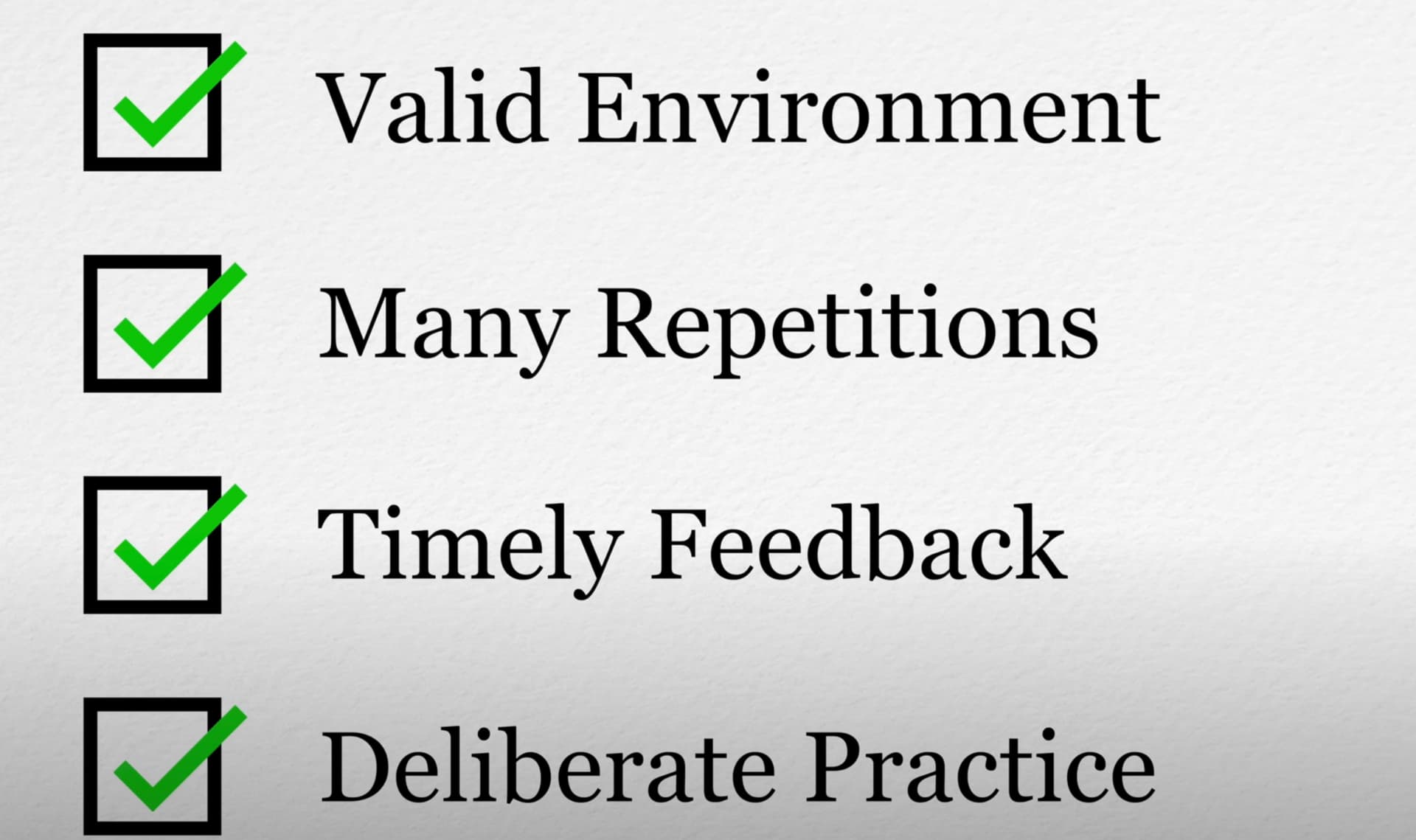
Put me in mind of this video on the component parts that contribute to becoming an expert. This bullet point list doesn’t give you the whole story by a long shot, but it does reinforce “Twiddle Daily”.
2 Likes
Digitakt is really good at glitchy ambient music. I use it more that way than as a drum machine. One thing I like to do to clear the cobwebs is to sample some melodic passage (myself playing guitar/keys, a jazz record, a video game soundtrack, etc) and then chop it up with DT. It takes some of the pressure off you to come up with a melody, since the melody emerges as you resequence the piece you sampled.
Experiment with the different chop modes (Slice, Werp, Stretch) and see what you can do. They each have a different texture. Slow things down or reverse then. As others have said, try to get a few ideas down quickly by copying between patterns and rearranging. Don’t try to polish one pattern until you have several sketches laid out, or you’ll paint yourself into a corner. Play with reverb and delay (time = multiples of 12 or 16).
4 Likes
You make it sound like its a failure that you havent finished something.
But at the same time you say you were having fun.
Music doesnt have to result in a finished track. People here or elsewhere on the internet might make you think that, but its just a hobby and creative outlet.
Ive picked up my guitar thousands and thousands of time without finishing anything. Ive made thousands of sketches on paper without posting them anywhere.
Just enjoy yourself and one day if you find a loop or whatever and feel its so good that you have the urge to finish and share it with the world - do that.
Wish you all the best of luck <3
6 Likes
Advice, I’m full of it!
I suggest you discard your “sum of the parts” approach to making music, in which you are getting stuck on step-one, “choosing the the parts.” In your case, those “parts” might be a sound or a loop. Rather, focus on the “product of the parts”, the ways in which all the different track sounds work together (or against each other). This may mean stopping treating sounds as “precious”, but instead, just choosing something and moving on.
I disagree. I think you should finish stuff. Unfinished work has a habit of hanging around in your brain, robbing you of working memory for the current task at hand.
In many aspects of life, I will argue for process over product. In this case, I believe that the only way to understand process is to follow process from start to finish. This is pretty easy for me to do, because the music I make (on my beloved Digitone) is simple, somewhat short, and based on preexisting melodies. The nice thing about a melody is that it has a start, a middle and an end. Before entering the first trig or twiddling the first knob, the macro structure of my piece already exists.
If my goal were to make something “original”, that would be trickier. I would probably start by outlining the large scale structure of the piece. Again, this is different than a “sum of the parts” approach. Teachers sometimes talk about backward planning. Describe the desired outcome, fill in the details that will allow a forward moving process to attain that outcome.
1 Like
Its not really something to disagree with though? As if there’s a factual way to approach this that works best for everyone.
Remember theres no end goal. The goal isnt to finish. The goal is to make music. And just because a hundred years of recording industry has groomed you into believing thats the only outcome, its really not.
You feel that you improve at making music by finishing more? Great.
This individual is clearly at their beginning of finding their creative process and frustrated.
I advice them to blame themselves less and explore the fun of creating.
Not sure you’re helping them but 
3 Likes
finishing a track doesnt always have to be about sharing it with the world. people can get self fulfillment from having tangible products of their efforts. OP appears to be seeking something like that. i agree that finishing the process can help people enjoy the process more.
4 Likes
I’ve been stuck in the loop factory since family, work and house swallowed up all my time. As said above, when I had the time to practice and develop my workflow, I finished a lot music.
Now I’m happy to have whatever time I get to make awful noise, also happy if it’s just a loop. Find a way to have fun with it!
5 Likes
It is reasonable to assume OP is open to technical advice. I’m sure they also benefit from your encouraging words, most of which I agree with. I’m not sure how things got personal. People can take or leave my blunt advice. I feel that should kind of go without saying.
Yesterday I accompanied a student violin recital on piano, then played in an orchestra concert. I live in a world of live music making. Each of yesterday’s performances was far from perfect (that’s live music), but they were finished. Not sure from where you pulled your comment about me being groomed by the recording industry.
As @schoolbabyboy mentioned, finishing a track doesn’t have to be about sharing it with the world.
1 Like
Didnt intend to make it personal, i see that it came across as such  The grooming comment was a bit mich. Apologies.
Regardless, i think its good for op to see some different perspectives. Mostly they seemed down and i wanted to offer an alternative to their current thinking.
The world you live in is not one i live in, nor do i aspire to. Its very cool. Most of my family does it, for me late in life music is just meditation, expression, time away from computers, often social.
I understand the benefits of finishing. I finish in many other parts of life. I used to finish music. With kids, demanding professional life, aging parents and little time, music can just be that - playing. Playing / improving with my son on the guitar, singing, banging shit. We dont finish anything.
Anyway ive spent too many words on saying the same thing too many times
Music is awesome, i wish everyone to have fun and not be frustrated
3 Likes
This is a common struggle. One potential solution, that worked for me many years ago, was to sit down with pen and paper and listen to the types of tracks that inspire you, the kind of genre you want to make. While listening, make note of what happening- the sounds that are playing, the patterns and especially how long a section goes for before it changes. Do this for many examples. You may begin to notice patterns or at least things about the arrangement you think are effective. This could then possibly be translated into different patterns you create on the Digitakt.
4 Likes
For me yeah, it’s kind of overwhelming too sometimes. I mean, I’m really starting at the very beginning. No experience at all. Bought a few devices, read stuff, watched a lot of Youtube. Biggest frustration is one of not having experience with the gear. That can only be solved by using it more. Family, work, kids…it all eats away at my time, but that’s just what it is, so I can’t expect to churn out quality stuff straight away without at least some decent mileage. For me the issue right now is translating melodies or ideas in my head to the actual machines. I have some rough ideas of what I want to compose, but not yet HOW to fluently tell the machine what I want. Next to that: creating the sound I want from the machines. Well, I just twiddle when I have time, use a lot of presets for now, stop when it gets frustrating, to continue later. I’ll get there 
1 Like
Just consider that the ultimate loop based music making device is Ableton or an Octatrack.
I’ve had a similar journey to you.
I’ve been doing electronic music now for about 3 years.
At first I couldn’t make more than a loop, then I could make a track that was one minute and even now I can get up to about 2-3 minutes before everything just starts getting repetitive. I have no idea how people do 6 minute arrangements that hold attention.
I had a bad experience where my SD got corrupted and I lost everything I was working on, so now I have a rule that I just post stuff once I’ve got as far with it as I want to go and move on. It doesn’t have to be a track to be valid music.
Here is a secret, if you can make a loop you can make an arrangement.
Lots of my early stuff you just start out with say a pad and a hi-hat and then you can drop in some bass and then bring the snare in etc. If you listen to a lot of classic house / techno it’s literally that + a few bits of automation to move the cutoff around, a few risers and fills.
It’s not going to make you Aphex Twin or Bonobo, but it’s a track
2 Likes
I don’t know if you’ve ever considered lessons, but in me experience - having taught Elektron gear these last few years - it can be very helpful as a way to get answers to specific questions, specially when they’re spontaneous. Also, I think some of the most helpful advice I’ve given is not so much related to functionality, but rather to workflow and creative strategies, ways to “unlock” ways of thinking and connecting parts of the machine that you might’ve not put together yet. Lessons are also helpful as a way to improve your own creations - for example, I often teach features or concepts around a track made by the student, that way they end up seeing and hearing the difference within the context of their own music.
1 Like
here’s to revival of this thread lol.
half a year passed, haven’t moved a bit. considered selling the DT, but have no idea where would I go since for a 300-400 euros, I think this is the best I can get.
so yeah, determined again to make it work, and inspired by the Tonverk thread to make do with what I have lol
what I realised is, and that was a problem with stuff I tried before DT… is rhytm.
I listen to a lot of modern electronic music, I select it, play it, my brain loves it, I feel it, love it. but tbh I know nothing about it, orvat least outside vadic 4/4.
So, I struggle with sequencers because I know so little about it. Sure, I can just do endless soundscape loops on DT and I know, but drums or something rhythm based… can’t get anywhere.
Think that’s my main problem in producing and basically with the DT.
you guys have any resources that could help? preferably not videos
I’m not the best at giving advice, but I’m going to try.
You mentioned earlier you’re stuck on loops, and you say it as if that was a bad thing… but I think it’s really not a bad thing at all?
I finish tracks every week, sometimes more than a few per week. I also have hundreds of unfinished projects. Countless loops. I treat those as future finished pieces. Maybe they will become a song, maybe they won’t. And I go through periods (currently on one of those periods) where I go through my unfinished projects and work on them. Some end up getting deleted, or end up changing everything about them that turns into a finished track that’s nothing like what it was. The patterns are maybe similar but the sounds aren’t at all.
Because you can make several tracks out of the same loop. And they can be wildly different.
So going back to the idea of loops, you do realise songs are made out of loops? They are a loop that got modified enough times and connected together on a string of loops that results in a finished song. You can make an intro out of a loop, a breakdown, a chorus or whatever you wanna call it, outro, and so on. It’s all the same loop with different iterations of it. Differing sounds, different instruments, variations in velocity or tone or timbre…
Perhaps your issue is a mindset one and not a gear/technique one?
Just a thought. Do with it what you will 
3 Likes
Get the free PDF of pocket operations here
Then reproduce some of these patterns on your DT. Firstly you will learn how to use the sequencer effectively. At first don’t change the patterns, just get proficient into copying them as they are into the DT, and listen to them. Start by genres you like, but also try some stuff you don’t listen to.
When you can reliably copy a pattern from the book into the DT in about two minutes or less, start changing the patterns. Move a snare one step up or down, maybe add an extra kick, but do very small changes. With just two or three changes from these basic patterns you have something that works, is somewhat unique, and can form a very solid base for a track.
If you think this is cheating, don’t. Listen to music you like, be it pop, rock, EDM, techno, whatever… most of the drum patterns on those songs will be 80% similar to one in this book, it’s those last 20% where the magic happens. The other 80% are the same for a reason. It just works!
And don’t even be ashamed of trying to do some tracks with unaltered patterns. They are absolute staples for a reason. In doing so, and not having to worry about a good drum part, you can focus on writing a catchy bass line on top of it. If you manage to write a good bass on top of a standard drum part, nothing stops you from tweaking the drums slightly later. This applies to all parts, not just bass, but of course, drums and bass go together very well and work very well as the foundations of a track.
Good luck!
9 Likes
I think most people would have less issues with internal blockage (and GAS!) if they had that readily available timely, external feedback.
I like what I do, have great friends and spouse, but I can spiral into fussiness without feedback and burn out a bit.
2 Likes
I know some people are self taught savants with instruments and music gear etc. but I never would have realized how much is possible and everything a Digi box could do without learning from and observing an expert. I echo the recommendation upthread of Dave Mech’s course although I’m sure there are other resources and teachers out there.
You sound like where I was after a few months of playing with Digitakt and the new car smell wore off. I hit a ceiling of experimenting with new approaches and they always led to a new and frustrating dead end and the feeling of not making any progress.
The questions you have around sequencing rhythm are exactly the types of things Dave talks about in his course. He shows how to use a second kick track and filter it to create a bass rumble sound that matches the key of the kick. He shows how to use the LFOs on the hi hat track to create interesting and constantly evolving movements.
Looking back on where I was, I would NEVER have figured these things out on my own noodling around with my “self taught” approach, and it took about an hour or so to learn these types of techniques and then apply them in pretty much every track going forward. It’s a small monetary and time investment to level up your skills and get way more enjoyment out of the machine.
2 Likes
thanks to everybody for all the kind advices and time that you took to write out your cooments and advices, I am definitely tryng or will try to implement some of those.
trying to fiidle with the DT, feeling uninspired while again, or still…
Idk, I’m betwwen making effort and forcing it. knowing what is right and actually changing the mindeset about it.
love the DT, but feeling like the groovebox concept is just not for me, so now I am looking for hardware thats going to help me more withe the generative music aspect. even when I try to get that kind of thing from the DT, I get stuck after I get the feeling that choosing and finding samples is becoming a chore.
wish I could go back the the feeling of beeing excited about the DT. I know all the troubles of GAS and all that thing. It’s my only instrument not counting the laptop anyway, and I am kinda sure another piece of gear won’t change anything inherently.
I am definitely not cynical about it, but I’ll guess I am going to try to save for Dave Mechs course, and hope that it will be different than watching constant youtube videos. I mean, I know it is, since it’s strucered, but the difficulty of sitting, watching and then doing it is alays there for me.