Monday morning, updating myself with the latest posts this thread, listening to audio clips (mostly @Jeanne), getting so excited I almost regret not having bought a second DN2.
2 Likes
Who knows what other gems are buried in there?
4 Likes
If you apply a random LFO and route it to your desired destination every note within that chord will have a different “sound”.
I thought about layering drum sounds, Kick, Snare, Hihat for example… from the sound pool
that’s not possible, why would you want that?
to layer drum sounds and copy those trigs wherever I want. This was possible on DN 1 I think


Sometimes I think about the features that haven’t made it’s from one box to another.
Try to imagine what the current groovebox would look like if Elektron had chosen to always keep the features of the previous iteration…
Would really the monstrous Frankenstein be as playable as the new DNII, or would it have some kind of Roland unbearable UX?
To what price?
I think Elektron chose a nice path.
14 Likes
+1 for giving us a performance window where all the macros are shown at the same time. And it should stay there when switching tracks, like it already does when you’re in the sub menu of a specific macro. The fact that they started to advertise performance macros as a feature in their new promo material on release date is giving me hope that we might get something like that. It’s always been a really powerful feature, but afaik Elektron left it to the users to talk about and explain that. Now they speak about it:
About MD having 16 freely assignable LFOs: Wouldn’t it be possible to set up a bunch of MIDI tracks and rout them back to DN input to send them to an internal track? If that works, DN would be able to send 15x3 LFOs to a single track that has 3 dedicated LFOs in addition. I think having 48 LFOs for one track should be enough  ? Like @Soarer, I also don’t really see the use in that and much prefer LFOs dedicated to tracks, 3 are plenty if you also have plocks and automation recording. But my music is rather traditional, so maybe I’m the wrong person to speak about that.
3 Likes
I way prefer the DN2 lfo setup vs the MD too, as much as I love the MD.
5 Likes
I used midi loopback on my DN1 yes. Was more complex than worthwhile, but it works. Difficult to remember what goes where unless you stick to setting things up the same way each time. Also these days I’m leaning more towards core sound and songwriting over needing to layer a hundred modulators to keep things sounding interesting.
One interesting thing I remember was using trigless parameter locks on velocity, using midi loopback to other tracks. Different track lengths on the midi tracks. That way I got more variation on Velocity since, unlike on the Oxi One, elektron sequencers can’t randomize or vary velocity of their sequences (helps with humanizing them.)
1 Like
I can imagine a Syntakt with the same “layering” ability as DN2 (along with MD/MM) and it wouldn’t be any more monstrous in my mind.
1 Like
Obviously, but at least DN II would give you the option to label the MIDI LFOs. I also don’t think that it would be easy on MD to understand what’s happening, but I don’t know how it works there.
I find it cool you’re thinking less about modulation and write songs instead. Cool if people enjoy stuff like what Sarah Belle Reed does in her video, but that stuff just doesn’t interest me at all, would maybe make a nice texture or interlude, but that music doesn’t make me feel anything.
3 Likes
So there’s 16 LFOs on the MD.
48 on the DN2.
And how often are you really going to use more than 3 LFOs on a track, especially when that would significantly reduce the number of LFOs available for other tracks? If you want say 3 LFOs on 3 tracks of the MD, that’s going to leave you seriously lacking in modulation on your other tracks.
I could somewhat understand this argument when we were talking about machines with one or two LFOs, but I really don’t think 16 LFOs shared between 16 tracks is better than 3 LFOs per track except for a few very specific things.
If they released DN2 with 16 LFOs on 16 tracks (freely assignable or not) people would be moaning that it’s not enough modulation.
48 freely assignable LFOs tho…

Although can you imagine the processing strain of 48 freely assigned LFOs…
16 Likes
Drugs man.
1 Like
48 freely assignable drugs

7 Likes
I think its odd that they made a better version of the screen/display cover for the e25 series, but chose to go back to the old ways with DN II and DT II. The e25 cover is better because it is protruding a bit and fits perfectly in the metal casing.
1 Like
Thanks for that, gives you a good idea what it’s like to work with this machine! It looks like a dream for sound design afficionados, but definitely a lot less immediate than ST. Even when using presets, it looks like it might take some time to think about how you would perform with different parameters, since there’s so much interaction across four pages. Might be interesting enough to just map the different decays and noise parameters to a macro though. Love the transients and noise btw, looks like a dumb ass like me could make some basic drums only with these. Also cool they’ve already built in mod stuff like for the noise parameters, so you don’t have to use LFOs for that. Reminds me a bit of A4.
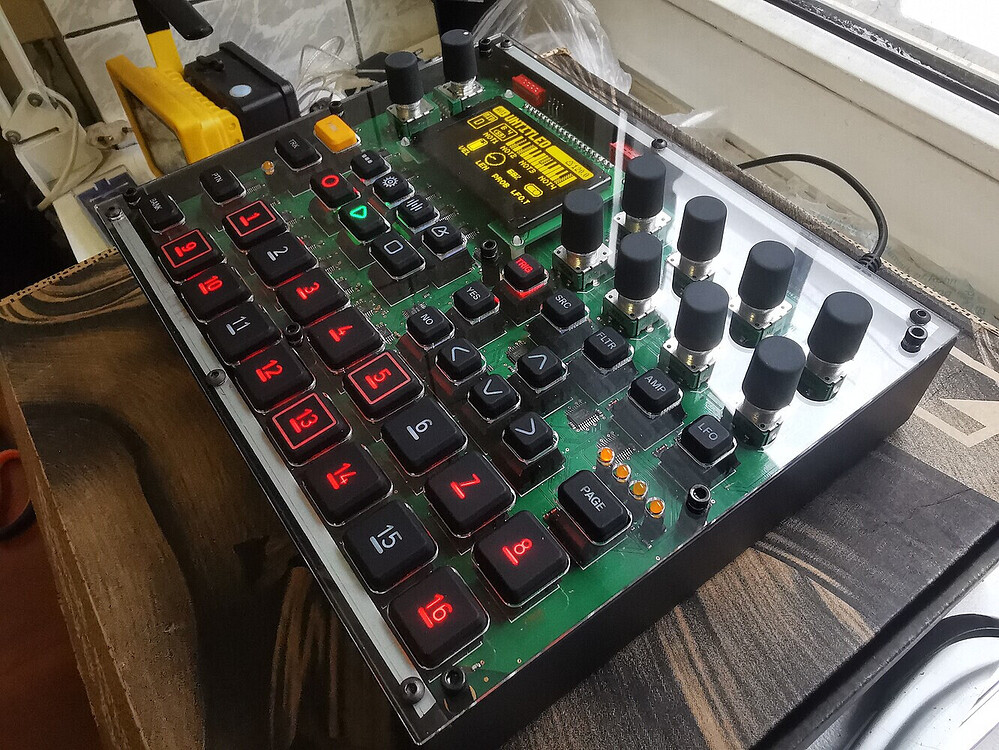
@dzyndzel: yikes, I love those 90s transparent machines like N64, but this DT defo needs some color!
1 Like