Sorry if I missed the information above but what is the primary gear used? What is your recording and mixing process?
Some songs, that sound not loud - I just used digitakt to make them and recorded them to a DAW and applied some features I’m really not familiar with. Then some songs that are loud enough - I made them in Ableton, added limiter and compression on the Master. So I don’t use exact gear at all times.
What kind of feedback do you want? Specifically.
Specifically what I can do so that bass lines and kick are more pronounced and overall if sounds go well together? Should they be louder and will it help?
You are leaving bad frequencies in the sounds. You need to work on finding them and subtracting enough to take out the harsh or conflicting registers. It’s not the same for every sound, but there are general ranges. You should look to define the area where the bass sits and differentiate it from the kick or carve out space for it.
Don’t think about each sound in terms of what you like about it specifically, instead figure out where it fits with the other sounds.
Some of these tracks have 3 or 4 sounds occupying the same space. If you want to do that you need to place them more effectively and eq them away from each other. I would avoid that though.
Also, some tracks lack any glue. Not just compression but the elements are too disparate. If a sound needs reverb, give that sound reverb. Don’t make all your decisions at once. Give your ears a break and reassess.
Also I don’t want this to be discouraging because nothing is wrong with the tracks, but the biggest thing about loudness is mastering and a lot of us have problems with that. You’ll find easier ways to master a good mix or if someone else masters it, a good mix will cut a clear outline for them to follow.
I’m not going to pretend my own mixes are great but this is all about listening and knowing what to listen for, so practice listening.
Music is fun and inspiring but for me, mixing is not. However, hearing your own mixes sound better is fun 
5 Likes
Learn about compression/dynamics. It will make you cry, and bang your head against a wall for a while, but will eventually make sense.
How to use it, when to use it, where to use it, and what compressor type to use for different purposes.
And what Shigg says above. Make sure each track is not overlapping in dominant frequency with any other track.
2 Likes
Thank you all for your suggestions! It is a long way to learn. I’m too focused on just recording the idea and not polishing it. I need to learn more!
1 Like
Are you recording separate tracks into the daw or a stereo mix?
1 Like
I recorded stereo mix.
1 Like
I do that a lot as well, it’s just more convenient for me but kind of a bad habit. It just means paying attention to your mix and levels on the device more carefully to achieve a reasonable result.
Do you use headphones only or do you have some kind of monitors? Other speakers? Do you check your mix on a phone speaker and also bad quality headphones? You can learn a lot about your mixes by listening to the same track on different degrees of bad or mid quality speaker/headphones.
1 Like
I use Sony mdr 7506 headphones and PreSonous 3.5 spekers.
1 Like
Yep, very convenient! Where can I listen to your misuc?
1 Like
The equipment is fine. I think the biggest thing will be more careful auditing of where each sound sits in the mix and tightening up the overall package. You may need to change the way that you’re using filters on the DT, or try multitracking because it will give you more room for fine tuning.
For me I just started paying more attention to the soup ingredients rather than just hoping that the soup turns out good, if that makes sense.
2 Likes
Yep, I usually throw everything I like and it doesn’t mean the result will be good - not everything goes well together when mixed.
1 Like
Wow they all sound pretty clear! I wish I had the same results with mine. The last track is especially lovely! I need to pay more attention to the mix as a whole to see what should stand out and what is unnecessary and go from there…
1 Like
Thank you, that’s a very nice compliment. One thing I try to do is adjust my mix to the sound I hear in the headphone out of the recording device. I think that’s the sound you’ll hear later in audio, so that’s where to listen for what you want to hear since the headphone outputs on hardware always tell lies. Recorder or computer, better to adjust the mix to that.
These ones above were all stereo track recording from various devices, mostly live performed, and then I try to work with that audio. Just to say, it could be better with multitracking but I’m very lazy and unmotivated. Don’t want to record. Don’t want to mix. Just want to make music and have it magically sound good. Unfortunately reality is not so kind.
Anyway, not sharing because it’s an example of what’s good, only because you asked to hear what I make.
Also thanks for listening and sharing some of yours
1 Like
A lot has been said already (and I’m not an expert at this) but if you need to apply a compressor on the master track to get your mix loud enough, your mix isn’t good enough.
Only mixing will also not fix all the problems. It’s more about placement of the instruments. Think about each element, think about its role and look at which instruments are being played at the same time. If your kick is overruled by your bass, you could cut some frequencies from the bass but sometimes it’s easier and more effective to nudge the bass a bit so that it won’t be played at exactly the same time as the kick. That way, the transient of the kick will still come through and that is the impact you’re usually looking for. Carve out some space for each element, this goes for the time dimension as well as the frequency range.
1 Like
The problem I have with these kinds of resources is they can’t teach you how to write your song, they teach you to write songs the way they write songs. I think the best way to improve your song writing is to take the songs you love and break them into parts and try to understand how they’ve built them and then try and build them yourself from scratch, focusing more on replicating the feel rather than the notes they play or the specific synth sounds they use. There will be lots of trial and error and sometimes you’ll make beautiful mistakes that will have you going off in directions that you didn’t plan to, but that’s how you figure out your own sound instead of replicating someone else’s.
The reality is, it’s just practise. It’s a different kind of practise than running scales over and over until its muscle memory, but it’s still practise. It’s like learning how to write poetry, or a screenplay, or novel. Write a little every day, even if there are days, or weeks, where what you write is complete garbage (there’s no downside, no one ever has to hear the garbage). The best piece of writing (words) advice I’ve heard, which I think also applies to songwriting is “I can’t write a great first act until I have my third act and I can’t write my third act until I’ve written a shitty first act.” So finish a bad song and then go back and rewrite it. Do this kind of thing consistently and you’ll get better at it quicker than you’ll realise, and you will sound like you, not some youtuber.
4 Likes
It is really hard to make non compressed stereo mix sound professional afterwards. I suggest you start monitoring and recording via Overbridge. Some concrete tips:
To make my drums punchy I:
(eq every channel if necessary)
Compressor on every channel (FET). Gentle, 1-6dB.
(Saturation if necessary)
Hard clipper on every channel. Gentle, snare can be clipped more.
Then I send those drums to a drum bus with different kind of a compressor (bus, low ratio, fast release and medium attack), a tape simulator, and again a hard clipper. Don’t cut too hard.
On every instrument:
Eq, compressor, saturate if necessary, soft clip. These I might send to a different tape simulator before master
Mastering: glue compressor, tape sim, surgical eq, character eq, soft clipper, limiter.
The order of the effects mentioned is how I normally use them. Disclaimer: I’m no pro, but I’ve done a lot of research on the topic!
Set up a reference track on one channel and route it so it does not go through your master but straight out of speakers. Bind some key to solo it and A/B. You should also download SPAN which lets you sidechain the reference track to your master track and also helps you mixing with eyes. This does not only work with mastering but with mixing as well. Before you add processing to master, lower the gain of the reference track so it’s at same LUFS as your track and balance your mix this way. Afterwards, remove the gain reduction and balance the master. Or roll your own sounding master, at least the mix is working now, so it should be easier.
I also use Airwindows’ Meter plugin. I am often too lazy finding a reference track and this works wonders combined with listening while balancing the mix.
I also have certain values on frequency spectrum that I try to get my mix to hit (using SPAN). Mostly lows tbh. I’ve come to these values by observing reference tracks with SPAN. I suggest you dial in these settings so it does not react too fast and see for yourself:
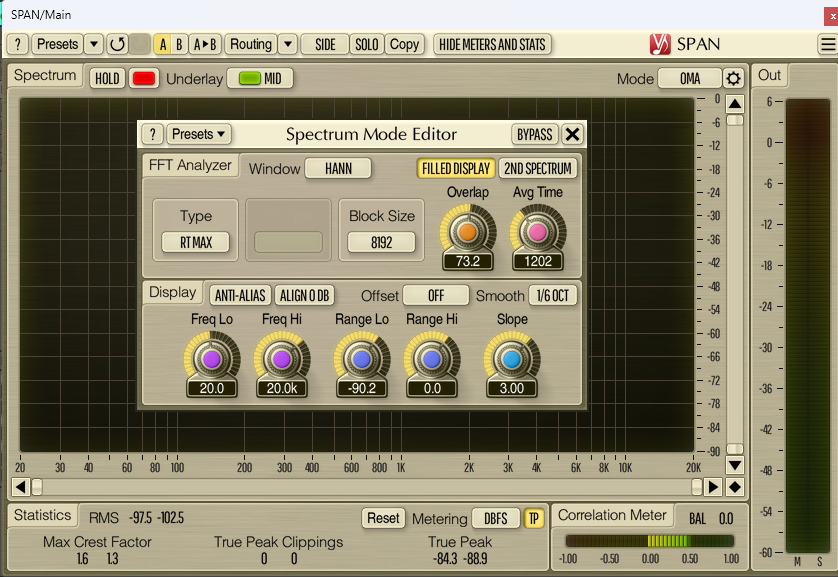
Or these values suggested by Dan Worrall:
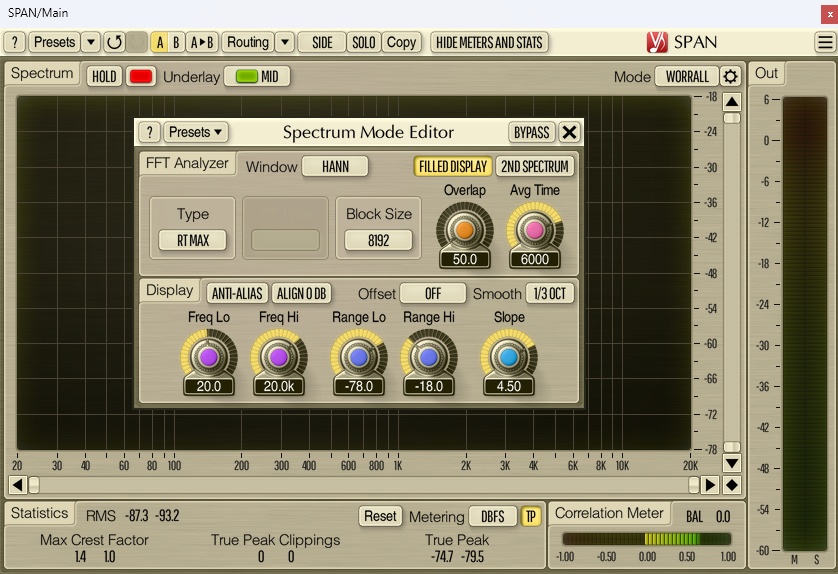
Of course these are not one fits for all recipes, but they should get you going. You can find every kind of plugin I mentioned as freeware, or use your daw native plugins. It takes time to start actually hearing what these tools do. Listen and experiment.
4 Likes
I played a few tracks you shared throught YouTube and looked at them using the Spectrum tool in Ableton. They all showed high levels in the very low frequencies, below 40hz, even below 30hz down to 20. This might result in your mixes sounding bad on a car stereo or other systems that struggle to play these frequencies. On a capable set of speakers those frequencies might come out, but be overwhelming. You might not hear these frequencies but any limiter or compressor could sense them and push your overall mix down making it sound quieter.
Those low frequencies appear to be from your kick drum or bass sound choices. I would start with looking there and seeing if you can solve the problem through sound design. For example, are you using a bass synth with a sub-oscillator? You might not need the sub. Etc.
1 Like