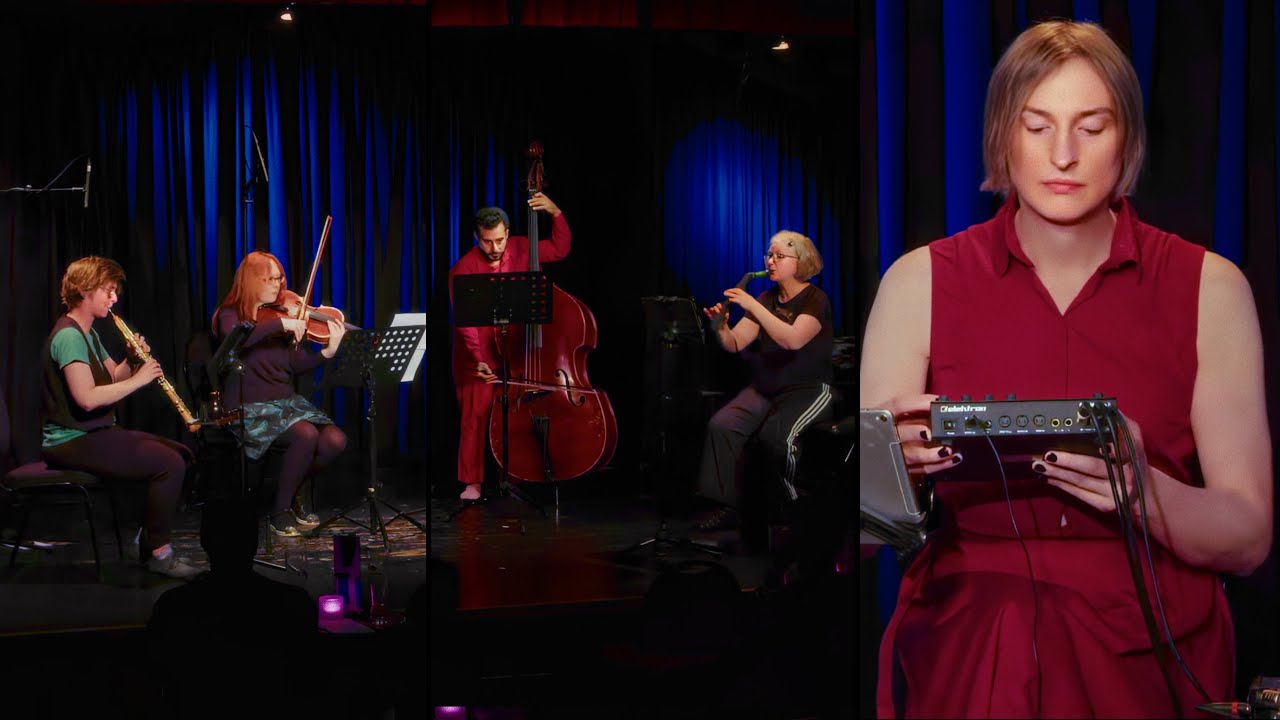
I am not at all a fan of trackers but I don’t think of the M8 as a tracker; I think of it as chunks of Digitakt and Digitone in portable format with a modified UI (which I actually prefer in some respects, despite the much more modest real estate).
I think Tim is not at all interested right now in creating a larger box, and even headless is probably more of a pain than he expected and he is perhaps regretting that, so he is probably not even likely to look kindly on licensing opportunities, because he surely would end up having to do support for something he doesn’t really care about in the first place. Possibly it would be as successful as M8. But not everything that is possible needs to happen.
The ideas of the M8 are certainly not copyright (many of them are present in the decades-old LSDJ software). So it is not beyond reason that someone will feel inspired enough to create something similar with more knobs and pads. But if you don’t want to wait, you should definitely check out the M8 itself.
OP, I empathize with your search. For me, playability mostly involves fumbling around with live note/chord entry, decent editing of those notes, creative sequencing, and encoders to do automation with.
I’ve owned the Polyend Tracker (OG, Mini, Plus) three times. It’s pretty unique as hardware comes and now and then I miss not having it. Specifically that’s because I really enjoy how it has a vibe to it and pushes you down a certain road musically. The limitation of 8x samples and 3x synth lanes makes you push for specific choices and to commit to stuff, which combined with the unique workflow is a lot of fun. I found the full-size Tracker easier to use than the Mini, on account of the pads and jog wheel, but still lacking somehow. The M8 seems similar and more powerful, but still lacks that “playability” you mention.
Polyend’s Play+ is an interesting one. In theory it should be a no-brainer, because it’s basically a Tracker but with a more accessible interface. That said, like the Tracker the pads are small, hard and not velocity sensitive. And there are so many stories of bugs (even more so than most Polyend devices) that I’ve stayed away. Even the bigger Polyend boxes are pretty portable, though not pocketable of course.
Ableton Move is such a clever box. I know that it’s not a sound design beast, as it’s made for quick ideas. But that workflow of getting ideas out on the sketchpad then doing the deeper edits in Ableton itself just eliminates extra steps from other hardware. This is kinda perfect for me. And now they’ve opened it up to take MIDI from external controllers, I can see something like a Launchpad & Move being a great little combo. As a quick, tactile jam box Move is my fav so far.
Obviously with Elektron being based on trackers I have thought that a DT/DN combo circumvents most of the limitations with the Polyend gear, at a price, and at the expense of portability, and also moving to 2 boxes rather than 1.
I’m not sure there’s a great answer to this one, it feels like you’d either commit to the tracker way (polyend or Dirtywave) and give up playability, or get a more “standard” groovebox at the cost of portability. I do think it would be cool to see a groovebox that combines those moderate limitations with a bunch of hands on control.
It doesn’t stand a chance with M8. I had it.
Sampling is very low bitrate. It doesn’t sound bad, it’s pleasant, but if you require fidelity it’s not there.
Requires a lot of attention to remember what is where.
Live note input is what I miss with M8. I’ve had a launchpad and it’s awesomely integrated but had to return it. Too much gear.
If I’d be Tim, I’d create a dock kind of device which adds 16 pads and some buttons and knobs to the M8. Basically you slide it in and it turns into an MPC.
I’ve thought of making my own but I don’t have the time to master a 3d software.
I have a friend that build a Leica Camera housing for his Panasonic sensor and board. Out of aluminum.
So it wouldn’t be hard to send over a 3D model to a CNC machine and have some nice casing, if you’re like me and hate the 3d printed plastic look
I don’t even understand the aversion to the hand held mpc, everyone knows that it would sell, everyone knows that it would be useful, and everyone knows that the M8 formfactor is beautiful and would be perfect… but there is some wild insecurity surrounding it… hopefully it’s an idea that comes to pass one day, it’s certainly long overdue…
there is some weird voodoo going on that dictates anything like such has to be a tracker… I remember when musicians were lauded for being the open minded folks among the masses, now days you request something like this and you’re breaching the societal contract
Not tried Woovebox here. I have quite big hands so anything that’s a big (no pun intended) issue on my side. I like portable stuff, but probably Tracker Mini is as small as I’d go.
Here’s my hangup, tell me if I’m wrong or taking shit too literally. What pad size and pad count are acceptable on a handheld mpc? I feel like 16 pads would be too small on something M8-sized, but any less than 16 pads would be unacceptable to the handheld mpc-wanter
Thought I’d comment here since the Woovebox is mentioned as a possible match.
In many ways, the Woovebox is a little bit like the “anti-M8”; not on purpose, or in a negative way, but purely because of the different heritages the two devices reference.
The M8 is the 2025 (and I suspect many years beyond!) logical conclusion of the hardware tracker and the tracker workflow.
The Woovebox is my old 90s / early 00s studio, packed into a tiny device, half/third the size/weight of your phone.
Sampling lies at the very core of the tracker workflow, and synthesis was only a later addition.
Conversely, on the Woovebox, sampling intentionally only plays a supporting role. Just like it did in the 90s; a time when sampling time was at a premium and we relied on synthesis and ROMplers much more heavily.
Unsurprisingly, if sampling and/or copious amounts of digital audio is your thing, the M8 absolutely smokes the Woovebox due to its unlimited sampling time at higher sample rates or bit-depths.
However, if synthesis is your thing, then it’s the other way around; the Woovebox’ single, full-fat engine can (needs to !) synthesize anything with higher polyphony and sonic breadth. To illustrate the point for people familiar with the M8; on the Woovebox there are no “baked” (resampled) chords or “special”/limited engines. If you want a 9th chord (5 note) playing a ROMpler-like, free-running, infinitely-evolving pad for your Jungle track, or a true 7-saw-per-note filter-key-tracked Super Saw as-Roland-intended-it for your Trance anthem, then the Woovebox engine will oblige.
E.g. it is trivial to synthesize something like this completely on the Woovebox itself;
…but all is assembled from just white noise, sine, triangle, square and saw waves in real-time, without a sample in sight for this “song”.
The M8 of course also wins handily if you prefer lots of timbres and instruments.
The Woovebox OTOH is “just” 16-part multi-timbral, commensurate with a typical 90s setup driven by, say, an Atari ST with its single MIDI port; this happens to be my favourite analysis-paralysis-free sandbox, but may not be enough for everyone.
And of course, the Woovebox is designed to be performance-friendly (it’s a “true” groovebox in that regard) for live scene switching and melody improv.
The M8 and Woovebox are very different devices with different design goals, workflows and - let’s face it - price points. Of course, there is some overlap in what they do and are capable of - just with very different raisons d’etre.
that’s a nice mini sampler, but not a hand held… the M8 formfactor is the hand held, the polyend tracker mini is almost crossing the line but would still work as an mpc handheld
I don’t think the M8’s size keys are too small, the wovebox keys are small but would work imo with a different style button/pad…
the polyend tracker regular sized model, just the pads would be perfect imo… put 16 of the polyend tracker pads on the M8, or put the novation circuit sampler pads on something the size of the polyend tracker mini +… the screen size of the M8 is perfect for sample editing… we’re just talking about an mpc that you could pull out of your bag and thumb around with like a gameboy…I can imagine the muscle memory would come and people would be flying around a unit like this
have you used any of the retro emulator handhelds that have been popping up the past few years? some of them have analog sticks crammed onto the control surface because the handheld is spec’d to run twin stick games but in practice they arent very ergonomic or fun to use, primarily because of the size of the handheld. and those are on vertical handhelds that are larger than the m8. the m8 already has 8 keys that take a majority of the space. places for the hand to rest without pressing any of the controls are important for a handheld to be comfortable and fun to use. i guess i just dont see how they could cram in enough pads along with other functional keys and maintain the non-visual muscle memory that is one of the main benefits of a handheld item. the bento seems to be the next best option.
i hear ya, nobody has tried yet though… the M8 and the Polyend tracker mini surprised everyone too…
hopefully someone will give it a try, there are handheld beatmachines that are smaller than the M8 already… first we have to get over the hump of no
The smaller you go, the more pertinent the DSP power vs battery life vs usability vs connectivity tradeoffs become.
You can spend a lot of time (=money, unless you like ramen like me…) on optimising the crap out of that, or try a more conservative approach. Or just not bother at all if you already have something that works well and pays the bills, and rather do minor form factor changes (with keyboard, without keyboard, with angled screen, without angled screen, with battery, without battery, etc.) to cater to user preferences other than extreme portability.
These are very broad guidelines, but in terms of usability, a note entry control should be spaced >7mm (center to center) to be at the very least humanly “peckable” (far, far from ideal, but is just acceptable in phone UI design), or 10mm-12mm to be fingerable/thumbable (much more ideal). 12mm is really the optimum for a basic on-off switch, if accuracy and comfort is paramount (which is what the POs, Woovebox, OP-Z, etc. use).
If you’re going the chiclet/“notebook keyboard” key route, ultra compact designs usually start from ~16mm+ spacing.
Velocity sensitive pads are a little bit of a different story; finger accuracy goes down as more force/speed is involved, so a bigger surface area to hit is really preferable if you want to make this actually useful to capture nuances. The mechanics & circuitry that are typically associated with velocity sensing also takes up a more physical room.
Actuation force and “feel” is also another can of worms, particularly when it comes to musical devices. If using a small device (and all the accuracy issues that this may cause) a ‘clickiness’ threshold + feedback (a sudden giving away of the button just before it makes contact) may be preferable over velocity sensing.
Other general ergonomics (shape, dimensions and - very important - weight) are also important considerations and will limit what is possible and desirable.
If your device relies on button combos (the likelihood of that going up as your device gets smaller), the ergonomics of that are also super important. And if your device has any screens, lights, indicators, control placement that does not obscure these during typical use, is also key.
All-in-all it’s a very, very challenging thing to do right, with a huge amount of interconnected factors - it is bit like herding cats. I love cats though.