True that! For me personally I like audio mute for drums as well. It gives it a more human touch, you can hear it was muted, in a rough way hehe. 100% subjective and I get the other perspective
1 Like
Interesting workaround, will try it, thanks! 
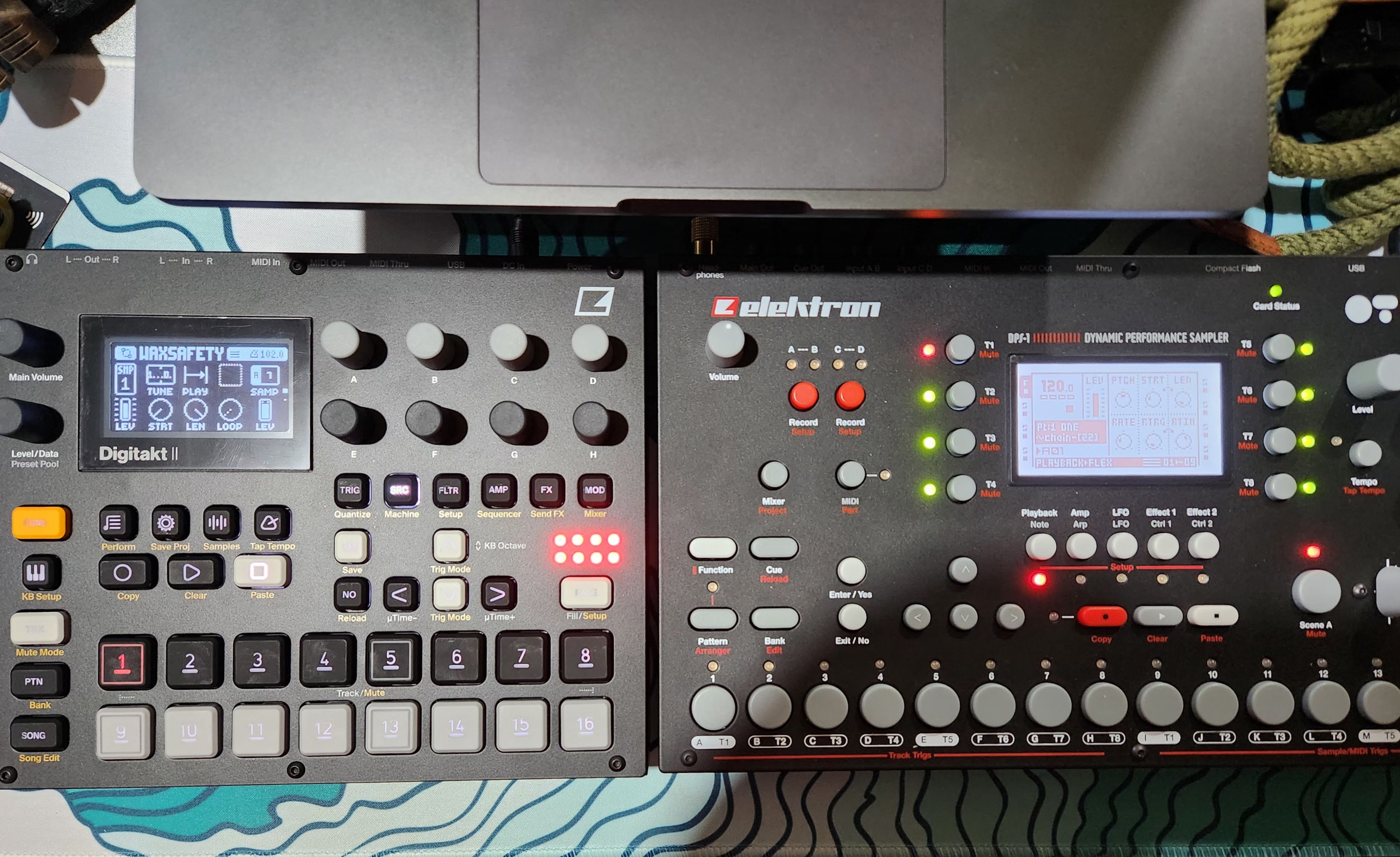
wondering if comb filter on OT and DTII are similar?
No, they are totally different. Sonically I prefer the DT one
2 Likes
Depends.
- As live mixer: OT works, DTII not so much
- As live remixer (record trigs): same
- Stereo samples: both
- Sound FX: both but different
- UI/UX: similar functions but different
- Time stretching: both, sounds differently, works very well with DTII
- Order: works differently (4 parts per project in OT vs kits, presets, preset pool in DTII)
- Number samples: 128 + 128 in OT, 1024 DTII
- Memory/+Drive: OT unlimited, DTII theoretically 20GB
- Transfer speed: OT USB3 (card) or 2.0 (cable), DTII: „modem speed“ (midi speed), that is, no joking, minutes vs days
- Size: different
- Overall sound impression: different
- Slices: OT editable, DTII grid
- Polymeter: both
- Special trigs: only DTII (Edit: some special trigs only DTII, and some only OT)
- Scenes, slide between parameter settings: only OT
I do understand DTII better - and love that it conserved the destructive work flow of DT1 (where everything is baked into the pattern) - if you want to (optional).
OTII has completely different logic but had easy mono choke sample selection on one track first (now DTII has that, too, but in a way that (in current implementation) hinders modulation of track parameters).
If it wasn’t for the bugs, I‘d rather go with DTII. But maybe that’s only because I don’t understand OT completely yet.
4 Likes
OT’s Swing trigs, slide trigs, trigless trigs and all trig modes (slices, chromatic, slots etc.) would like a word 
6 Likes
Correct: some special trigs (I think all with probability?). Thanks for the correction. I am aware of recording trigs etc.)
1 Like
I just whipped out the trusty OT…and was once again blown away.
Doing some CBA MOOD stuff like:
- live-reversing (CBA slip mode)
- micro-looping (using OT’s plays free tracks)
- mimicking the slow clock by (is it just me or does OT SRR sound better than DTII?)
- all kinds of routing & fader-fun
A lot of this stuff can’t be achieved on the DTII!
9 Likes
I think if you handed any open-minded musician in the world an Octatrack (and maybe talked them through the manual), they would find a way to enhance their music with it. So I’d say deffo get one if you can afford it.
The only way I could see it not being that useful is if you plan on only using your setup to write tracks, sequence them in song mode, and then record a final version with minimal ‘live’ adjustments/performance elements.
If that’s it, I think you can probably get away with just the DT 2 and the rest of your current setup.
Anything more than that, especially if you enjoy playing hardware in any sort of live set/free-flow jam setting, I think the Octatrack is fantastic.
2 Likes
With a lot more expressive mono synth controls (vel mod, full-featured portamento, PB/MW/AT/BC mods, smooth wavetable scanning in grid mode, chorus, comb, other filters, master overdrive) … for me it’s a lot closer to the Syntakt, as a sort of sound design playground that’s deeper than it first appears, now.
I won’t touch the OT comparisons, but I do think the performance options are also greatly expanded on DTII relative to the DT…
2 Likes

A new thing worth mentioning is that on the DT2 there is a LST (last) trig condition. So if you are changing patterns you can now put a lock trig with LST to set the volume to 0 at the end of the track with the long sample.
10 Likes
Wow, that’s so useful. Does that work with song mode too?
Yep, it does! When a song row initiates a pattern change then the LST condition is true.
You can also use NOT LST for the opposite.
3 Likes
DT very close now
These are the kind of small features that I hope will make their way into the Syntakt too.
What exactly do you mean with this?
The factory wavetables, in grid mode, scan between the 64 slices in the manner of a basic wavetable synth. There’s a little stepping sound on some of them (they don’t interpolate) but no pops, and they make very good basses and lead sounds. I haven’t had the same luck with other wavetable files I’ve thrown at it so far, but haven’t investigated much.
2 Likes
Thanks for the explanation. I didn’t know until now that DT includes wavetables among the factory samples. Were they already included with the original DT?
I made some for DT1. 64 waves max. Auto-zero crossing can change tuning depending on waves.
No. Slice machine didn’t exist before.