There is no proper envelope in v 2. Maybe a basic decay parameter?
V. 3 has more features like note off. Maybe that one has full envelopes. But I doubt it
TL;DR started as a reply to OldmanChompski… and goes off sideways into a philosophical rant. Enjoy 
The difference between 12bit on one device and 12bit on another device can be as large or small as the differences between chocolate chip cookie recipes.
Imagine if you will that your sampler is a chocolate chip cookie. It’s made of sugar, butter, flour, water, and of course those yummy chocolate chips. Even if you constrain your baking to just those ingredients, you can make a lot of different chocolate chip cookies because the ratios of ingredients matter, the methods you use to mix the ingredients matter, and the temperature and time that you bake matters. Many people, especially those who just like eating cookies, probably won’t notice the differences between different styles of cookies. Sure their notice the surface level taste, texture, and deliciousness, but they won’t be able to pick out any depth of what went into making any particular cookie. Before I drive the cookie metaphor off the cliff… let’s get to samplers.
So you’re aware that there are different bit rates for sampling devices. 8/12/16/24/32 are all pretty common bit depths, and there are certainly more exotic odd bit depths, and sure you can get lower, but that’s “insane” TM. The bit depth is basically representing a number of how loud a sample is at any given moment in time.
For example, 8 bit samples really only have 127 variations of loudness (2 to the 7th power, - 1 because we need a zero point), and the 8th bit is basically determining if the audio is positive or negative. Now, where things get fun (and you can extrapolate this to larger bit depths) is in how those bits are mapped. You can go linear, so 0 is silent, 1 is as loud as you can go, and 127 is just 127 times louder than 1, but this isn’t really great because volume, and how we perceive, doesn’t really work that way. So usually what you’ll find is that 0 is still silent, 1 is pretty quiet, but 127 may be logarithmically louder than 1.
Keep in mind I’m grossly generalizing here… but the slope or loudness value per bit, really can make a difference. Depending on how you tune the values of 0-127 will greatly determine if the sounds you can produce and reproduce are effectively “neutral”, or if they skew more towards a bass or treble sound.
Let’s skip on over to frequency, or as you pointed out 26.01hz (or whatever value). This is telling you how frequently you are going to take a snapshot of a sound. This also isn’t exactly straightforward either though, because you may sample at that moment in time exactly what the value is, you may take an average between the start and the end of the sample “slot”, or you may have something fancier to account for problems such as tuning for a human voice. Honestly though, I’d say most of the time the frequency/sample rate is far more straight forward to understand than the bit depth because in general, it just comes down to how often you are capturing a snapshot of the audio.
All the above said though, sample rate and bit depth, coupled together, can have a significant impact on your ability to capture and reproduce a sound.
Now into the esoterica… compared to modern sampling standards, the S950 is… I’ll say weird, and although there are nice effects/facsimiles for it, they aren’t exactly straightforward to reproduce, and I suspect most people wouldn’t bother to reproduce the whole thing, because it just doesn’t work the way more modern 16 bit samplers work.
First, the S950 is a 12-bit sampler, though there is a 16-bit replacement board. The samples are actually still 12-bit, but due to the extra 4-bits, the upgrade allows it to reproduce sounds with a lowered noise floor… like magic. Anyways, the 12-bit part is relatively straightforward, and I’ve heard some effects that get a straight “12-bit” reproduction of the S950 to sound more or less correct to me. Whatever they’ve done, they’ve been able to match the slopes to downsample the audio down to 12-bit.
Second, the S950 has variable sample rates, and this is the party that makes it harder to implement as an effect, because as odd as it sounds, you can make a key group with samples of various sample rates (ie sample frequencies) and the S950 will reproduce the sounds for each sample at the appropriate sample rate. It’s not exactly rocket science, but in a modern environment where you have plenty of RAM and storage for samples, it’s not a big deal, but on the S950, you may very well decide to record a bass heavy sound at a lower sample rate because it sounds good enough, where you might use the max sample rate for a higher note sound because you need the extra sample frequency to capture the nuance of the sample.
Third, the S950 plays back these 12-bit variable sample rate samples, at different speeds, by running the voice chip at different frequencies. This makes for a very unique sound, because you can sample in at whatever frequency makes sense, and then the S950 will play the sample back at the appropriate frequency based on the note that you are playing at the time. So unlikely modern samplers that will do all kind of transposition and time stretching to get a sound to play at the right frequency, the S950 just slows the voice down or speeds it up to get the appropriate pitch.
The first two points can be pretty well approximated by fx these days, as you’re really just going to dial in a number and setting the value the bit depth and frequency. It’s the third one that gets goofy, because the S950 can play 8 notes at the same time, of various samples at various sample rates. It’d require building a specific sampler with this characteristic in mind in order to emulate the S950, and while it is possible somebody has made this, I’m not aware of one off hand.
Let’s keep going though… because there’s definitely more to consider about the sound.
Input matters. The S950 has analog inputs by default, but there’s also a light pipe input. The analog input is by its nature going to have signal noise, so you have to account for that, and if you distort the input of the S950, because of the nature of analog circuits, it’s not going to give you digital distortion. On the flip side, if you’ve got the ib105 or ib109 (I think those are the product numbers), you can get digital input, but you’re going to get digital distortion when you record. It’s super easy to mimic the digital distortion, because well… it’s what digital does, but analog distortion can be a lot more subtle.
Obviously converters from analog to digital matter as well, but typically you’re going to get the most “character” based on how the slope of the bit depth is tuned in my experience.
Moving along… I suspect that the S950 has noise filters on the analog input to reduce noise, and I’m quite sure that there’s some kind of filter when the audio is playing to help smooth out playback artifacts from both the bit depth and sample frequency. Am I guessing at this point, yes… it’s been a while since I’ve taken a peak at the S950 innards.
The S950 also has a non resonant low pass filter. This also seems to be pretty well emulated by modern fx chains, and it wasn’t exactly anything fancy to begin with on the S950.
Mixing audio signals can impart a bit of character on samples as well, and on the S950 you might not notice if you are just playing back one sample at a time, but when you play chords or multiple samples at the same time, this can also have an effect. Most modern gear is going to mix samples in a 16/24/32 bit digital domain, but if I remember correctly, I believe that the S950 has an analog mixer stage… though I might be wrong here.
Anyways… that’s just a loose overview of the S950 architecture. I probably got a few things wrong along the way, but hopefully the bulk of it all makes sense.
What are my take aways/suggestions? Well… the S950 does have a lot of distinct character and attributes, but it can also be really obtuse to use. Modern FX can get you a pretty good facsimile of the sound, so if you’re in a DAW or working digitally I think it’ll frequently be “good enough” and can help stick with the workflow.
On the flip side though, I’ll be honest, all this older gear, if you’ve worked with it, you know it is pretty special and unique. For me, it is about forcing myself back into older workflows, methods of thinking, and being more thoughtful about what I am doing.
This is not for everybody though, as not everybody wants to be forced into working with mere seconds (well a minute or so with maxed ram) of sample time, and not everybody wants a number pad and a single data wheel to be their only way for entering data to program their device.
How important is the effort and care that you put into making the music with the S950. The vast majority of people would never know you used it, and probably still wouldn’t care if you told them. An S950, like pretty much any other synth or sampler, won’t really stand out as an S950 in proper mix either. So I don’t know… if you’re going to do it for yourself, then rock on, otherwise just be ready for the S950 to break your heart.
Last thought, and this for me is the important one. If you’re dreaming after “that sound”, my advice is to stop chasing that particular dragon. Yes the S950 has a unique sound and character to some extent, but you’re probably missing the bigger picture. Most artists that used the S950/MPC60/SP202 or whatever… they were frequently using all kinds of other gear between FX, mixers, multi track recorders… every step went into making that sound… and I’ll be perfectly honest… most people aren’t interested in recreating the entire environment that these artists and classic songs were made in. Take a bite of the process and workflow for sure… but I’d suggest to not get hung up on it either… make stuff that speaks to you… work the way you want to. These older devices are finicky, require maintenance, and can cause just as many headaches as you can imagine.
15 Likes
The time stretch on the S950 is a pretty unique algorithm from my experience. This does not mean it is good (or bad) by any means, but I suspect most people would get laughed out of town if they implemented time stretch the way the S950 does it. The best way I would describe it would be if you made a single voice grain cloud, that only played forwards, the grain size was kind of whacky, and there wasn’t really any smear mechanic.
You can definitely get interesting results out of it, and with enough time can get a pretty good sense of what it is going to do, but boy oh boy is it a slow process. You dial in your settings and go make a sandwich, drink some tea, think about what you’ve done in your life…
3 Likes
Thanks for the write up, I read it all. I knew there was lots of different techniques back then including using analog filters on the input and output of some devices to help soften the aliasing which also gave a unique character.
But I’ve definitely noticed that from sampler to sampler even if I set the bit rate the same the sample didn’t sound identical. Close enough? Sure. It wouldn’t matter in the long run and within the context of a mix, but definitely different still.
The Microgranny is an 8bit sampler and I still haven’t really been able to get its sound out of other devices. Same with the S2400. Even emulations of the SP-1200 like on the modern MPC or Maschine didn’t sound like an SP-1200 really (or as far as I can tell with my S2400, which I’m sure is as close as you can get without buying a real one).
And then I look at the SP-404 MK2 and using the lofi modes… it doesn’t make a sound that sounds like the sample is low bit as much as it sounds like a filter is on top of the sound (filter in the definition of a photo editing app, not audio filter)… I never really understood why.
2 Likes
The Rossum Assimil8or claims to do drop-sample interpolation when its aliasing parameter is set to (IIRC) 89%, on any or all of its 8 voices. I’d love to hear some nice examples of it but I haven’t had much luck in the searching I’ve done.
A good, in depth thread about various different methods of pitching on older hardware can be found here if anyone’s interested. Apologies for the GS link but acreil’s posts have often been one of the very few reasons to visit that place over the years so hopefully that balances it out 
I have an assimil8or, if I get some time I can try and run some experiments with it for interpolation across 8 voices… guess I’d need to do some more research first though.
2 Likes
Ooh, nice! Would be much appreciated. I haven’t heard software emulations that quite get me to screw my face up in appreciation in the way some vintage samplers can (whether the smoother S950 style or grunge like the Mirage), though the SP950 VST is pretty decent.
I wouldn’t be surprised if the Rossum was the one to finally do it given how much of a stickler for quality he is, but it does seem far more focused on pristine pitching which it seems to do incredibly well.
If it really can go either way I might go for it over risking decades-old hardware.
1 Like
There is attack and fadeout (decay) in V2.
You dont really need sustain and release on drums.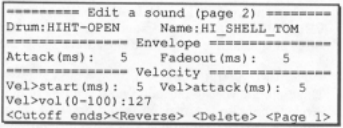
1 Like
Yeah, there are a bunch of minor differences between mostly older devices which makes for some interesting results. I think clock per voice for pitching is a big one and more Hifi in a way as it sort of incapsulates the best of the era, like the next in the line is the s1000/1100 and it uses windowed sync interpolation which is also quite interesting, but at a certain point memory size allowed for bitrate and samplerate to became high enough that linear interpolation was good enough, linear interpolation is quite cheap on CPU so voice counts could go up. I think this is the usual stumbling block of modern “lofi” gear, just sticking in linear pitch interpolation. But even down sampling can have a flavor based on what algorithm these old units have designed into the attempt to pull the best out of it.
Wow! What an incredible read and insight to how all prospective parts interface together, The S950 almost sounds mechanical in some parts of your description.
There are some very valid points outlined here but I would like to second your affinity with the machine itself.
I have accumulated a bunch of vintage hardware gear over the years which I am very fortunate to have been able to acquire but ultimately that collection of instruments is controlled by a computer and there lies the problem.
The sound of something is of course very important but inspiring tools and interfacing with those tools is also a huge part of the writing process.
Perhaps this is likely a generational thing but I have found over the years that I have always enjoyed looking
at tiny lcd displays, zip disks and hand written notes.
Yes those old units are somewhat clunky and cumbersome but they are also immediate, hands on and have tactile control, instant feedback.
No mouse or monitor needed and above all a very limited visual representation which forces me to think more about where a project is going, and how to connect technique with ideas.
Don’t get me wrong I absolutely love using computers and DAW’s but they tend to remove much agency from music making with a big emphasis on GUI and time lines etc.
These older machines still evoke mystery to me and encourage you to push your ideas on and achieve something that you were not entirely sure was possible on said machine which feels more rewarding and exciting in the long run.
1 Like
sound here:
1 Like
This is great! thanks so much what a well of information here. Brilliant
1 Like
And I think in answer to the thread title: no, not really.
1 Like

It was great to listen through these thank you.
Can I ask is the original loop in stereo?
the examples subsequently sound like the soundstage has shrunk - which makes sense as the s950 is mono right?
Thanks
1 Like
Yes, original loop was in stereo. Good point  All files all downloadable.
I loved s950 for the transposing algorithm. It sounded super realistic, The best i’ve ever heard on drum brakes. Very organic sounding imo.
Ok that makes sense, Thanks for clearing that up
From the Assimil8or manual:
Here’s what the various settings of Aliasing do:
From 0% to 25% aliasing, only the aliasing while pitch shifting upward will be affected. What is happening is that we are reducing the degree to which we track the alias reduction filter to the pitch. Higher pitch shifts get more and more aliasing over this range. Beginning at 25%, the pitch will no longer affect the interpolator filter at all.
From 25% to 36% we gradually reduce the steepness of the anti-aliasing
filter, gradually allowing more aliases. Somewhere around 31% the quality will be that of the G-chip, as used in all E-mu samplers since Proteus, Emax II, and E3X. At 36%, the quality is similar to what was used in the EMU8000 chip that powered the Sound Blaster AWE32.
From 36% to 51%, the interpolator transitions from a brick-wall lowpass filter to (at 51%) a linear interpolator.
From 51% to 89%, the interpolator transitions from a linear interpolator to (at 89%) a drop sample interpolator. Linear interpolation is used by most sample playback engines; drop sample was used by instruments from the PPG, through the Ensoniq Mirage, to the SP1200.
Beyond 89%, the “extreme alias” regime is entered. The interpolation filter no longer remains lowpass, and aliases are emphasized. At 100%, the filter has a highpass characteristic, so the aliases are louder than the fundamental sound.From 36% to 51%, the interpolator transitions from a brick-wall lowpass filter to (at 51%) a linear interpolator.
I should have some time today to record off some examples… I’ll see what I can come up with for a few different loops, or maybe I’ll export some stems for a song I’ve been messing around with on the MPC… shrug
So if it sounds good it is good… but I will mention, and what’s alluded to here… “similar” isn’t the same thing as replicates… obviously not going to be a drop in replacement, but clearly should be able to ape some cool sounds.
3 Likes
Cool, thanks for remembering! Maybe some familiar stuff like an Amen break pitched way down would be useful so there’s a frame of reference?
I’m not sure emulations/algorithms will ever be dead on but I’m curious as to whether the Assimil8or gets closer to that older character or has one of its own that I like. Particularly the 89% setting since they’re very specific about the drop sample behaviour there.
Yeah I might have to take a different approach here… and maybe grab an amen break or something…
I exported the loops from the MPC, and oddly the BPM is not matching… I’m doing all the sample math and everything is working out properly, but it’s almost as if the Assimil8or is playing things at a slightly different speed/pitch… got a bunch of things going on for the day, but I’m now getting a bit twisted because the Eloquencer is sending a 96bpm/2 bar gate to the Assimil8or, and the Assimil8or is playing the loops in sync, but it isn’t lining up properly with the tempo of 96bpm… so I have to slow the bpm down to about 93/94 to get it awfully close… I tried clocking from the Pamela’s Pro Workout and it doesn’t help… so I’m not quite sure where this oddity is coming from. More interestingly when playing the loops on the Assimil8or and the MPC at the same time, they shift out of sync… so I’m doing something wrong…
Will keep at it though and see what comes of it
EDIT: Here’s a video of the problem I am having… it’s like the Assimil8or is pitching the sample down a tiny bit… which is… weird. https://youtu.be/2xkGvQhSw6g
I’ll keep poking at it, and might just pivot to working with a more standard sample.
1 Like