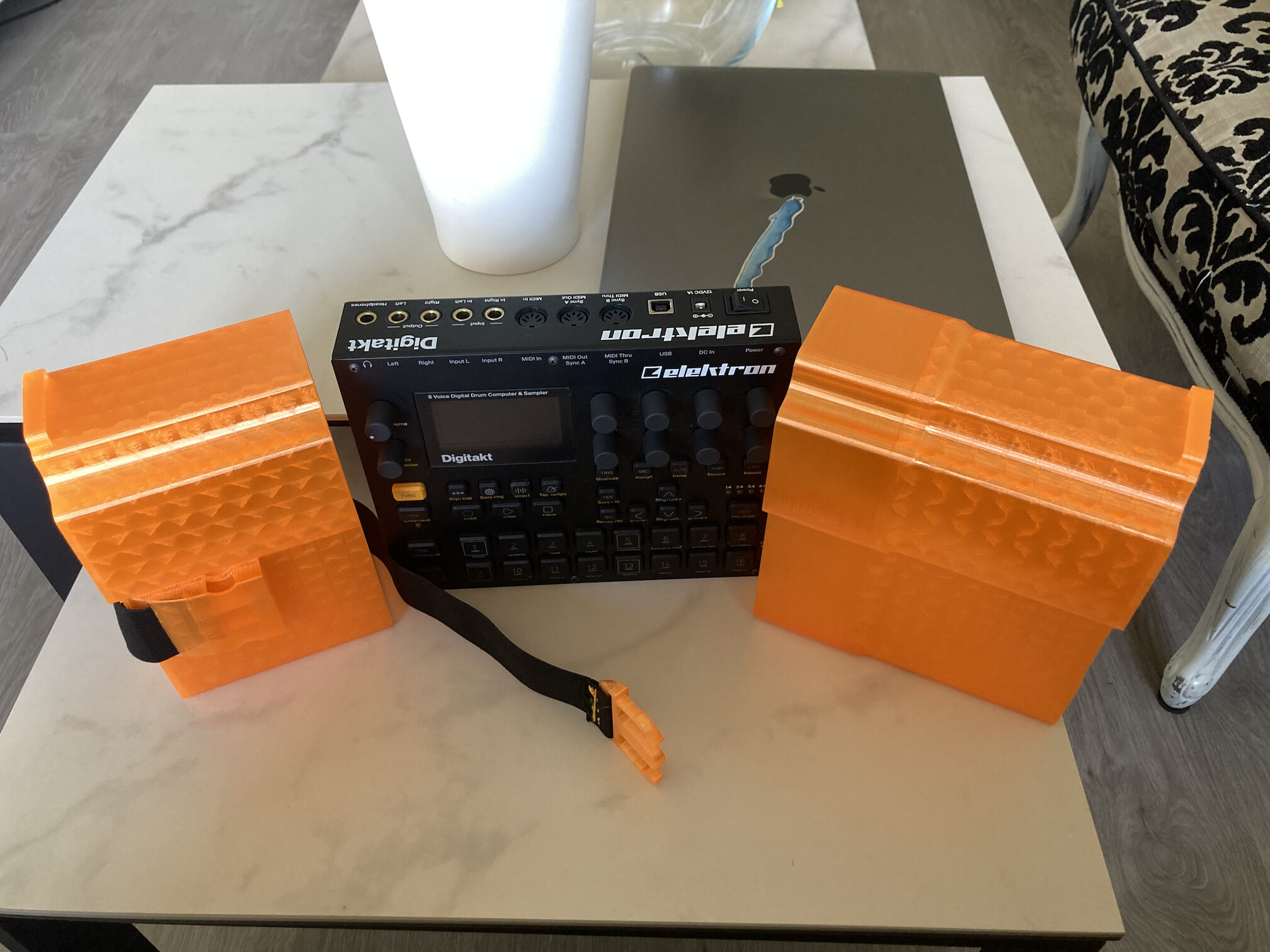
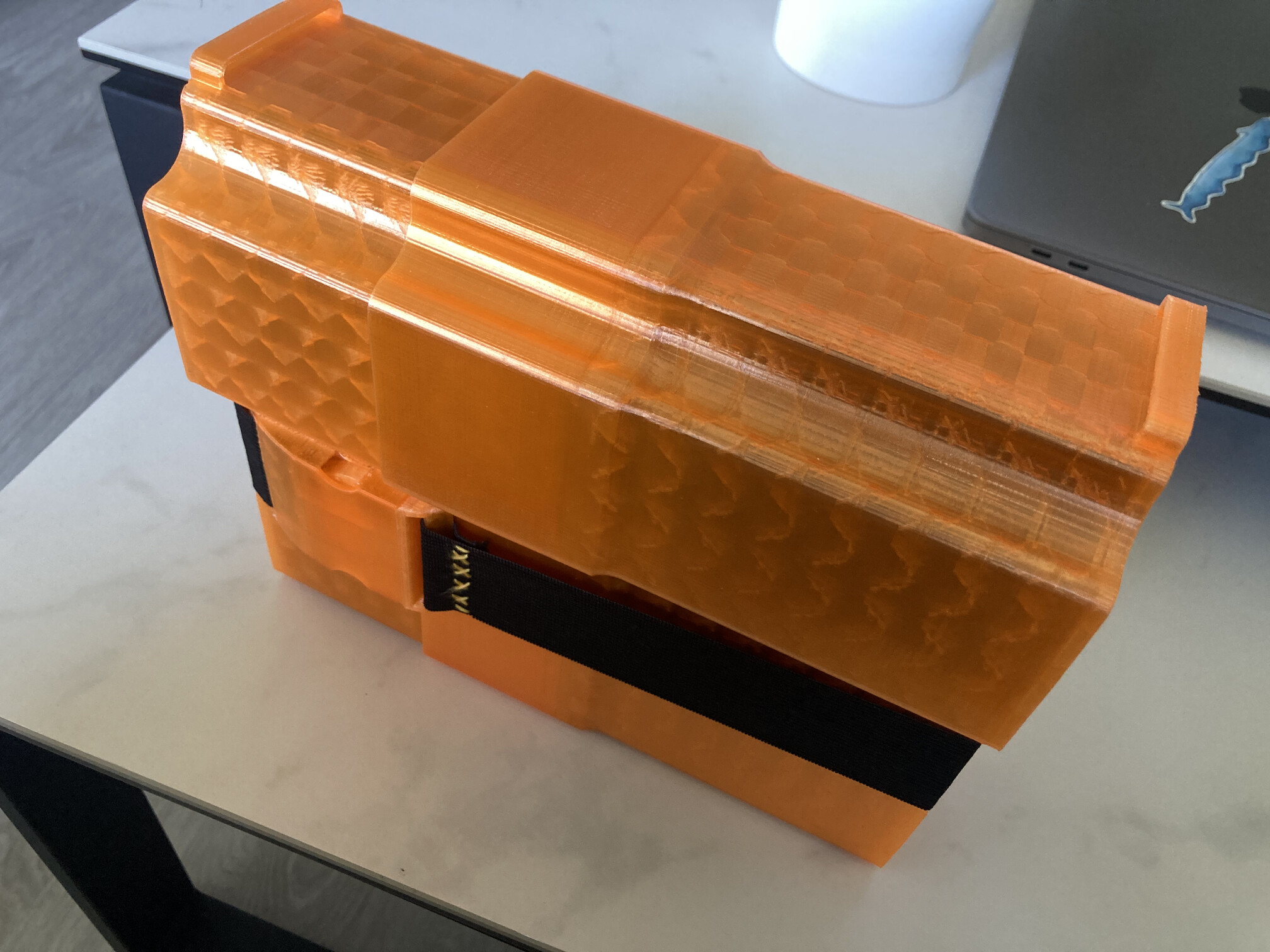
Hello, I thought I‘d show of my latest project, a 3D printed carrying case for the Digitakt.
It‘s designed in two part that slide into each other, enclosing the DT. A build in buckle system prevents it from opening.
I choose the DT color pallet of black and orange for the case. I also choose an interesting infill to give the translucent filament some nice visual texture.
There are bars on top to add a carrying belt or similar things.
You should Kickstart this. Might lead to a full line. Decksaver appears to be successful in this niche. I use their products religiously to travel with my OGDT, MiniFreak and 505 and would buy one of yours if was commercially available. Scaling up production with a 13+ hour build time would be difficult. How could you shave off a bunch of time?
Looks cool. You should really stress test those strap eyelets on top with something heavy inside other than your DT before you commit to using them for carrying it around. The matching buckle around the middle is a nice touch, great appearance. Thanks for sharing.
I don’t know a lot of the technical details but 3D printing is generally pretty slow, my understanding is that you’d probably need a printer which costs 3x as much to build or 5x as much to buy something commercially built, or you might save some time by changing the fill pattern and percentage but again just from my understanding that would significantly impact durability.
For a production run you’d probably need commercial scale 3D printing which would generally be more costly going through a third party and still time consuming, or upgrade to something like an injection molding process which would be a whole other ball of wax, very costly requiring molds to be tooled.
It’s probably best as a DIY project, print at your own risk. Each person accepting any risks that they take as a result of their own printing choices is probably best for OP in the long run. Besides, in any event it was already very nice of this person to provide the files.
If there is interest in it i might put up an Etsy shop for it.
Reducing print time will be difficult and at best could go down to 11 or maybe 10h per print while printing reliably. The alternative would be injection molding, which has a very high up front cost due to the custom molds.
Injection molding allows more precise control of the end product and is usually done in an assembly line fashion, it’s like, the commercial standard I guess you could call it.
But the molds have to be tooled very precisely and even if they’re scratched they have to be repaired and that’s also expensive. It’s why some plastics can be very smooth to the touch, because the surface inside it smooth like glass or something.
Also allows the pressure of the injection of hot plastic to fill the space rapidly and cooldown time is quick, set time for thermoplastics is also very fast. Turnaround is like what you’d expect for a commercial shop I guess you could say, people who really need to crank out units.
Silicone molds aren’t going to have the same level of detail or uniformity (conventionally) but people do DIY silicone resin pour molds a lot.
Injection molding is only viable for big quantity production done by an outside company or factory. Starting to make moldes myself, demolting and doing the cleanup work al by myself would not be viable either. Don’t forget that in the best of cases 13h of printing is actually 5 minutes of prep time and 12h55 of just letting the printer do its thing.
If there was small interest I would look into printing cases on demand.
It would need an enormous amount of people interested in buying it for me to consider a different manufacturing solution, especially since i don’t have any experience with injection molding.
I think that it’s probably smart to limit this to a resource, but you could certainly set up a github page and then I’m not sure if you’re aware of kofi, but you could link a kofi page from github and do some prints for people from there if you want, you could also link your makerworld page (I’m not sure if that site allows links to ko-fi). Etsy overhead is very high for sellers. Bigger market, but the cost and headache to the seller is much greater. I probably wouldn’t want to deal with it.
For kofi I think the biggest thing is figuring out shipping since you’d need a domestic and a global shipping rate that you could quote people, etsy is a little more straightforward about that part.
Speaking of scaling things up. Can you imagine milling out 500K iPhone cases a day? Let alone organizing all the other screws and stuff. I just make a dozen burgers and need a nap after.