The site seems to be down right now … this gives you a bit more idea what’s going on
EDIT: Doh … of course the kickstarter page tells you a lot more.
The site seems to be down right now … this gives you a bit more idea what’s going on
EDIT: Doh … of course the kickstarter page tells you a lot more.
You talking about the link i gave.
It’s up for me. You might be down.
I am thinking of this as a dual ribbon-tar, with a magnetic sensor for attack and envelope, with either the ToneSprings, or the AirPick for activating the magnetic sensors – and some nice paint.
There is the electronics and the controls too.
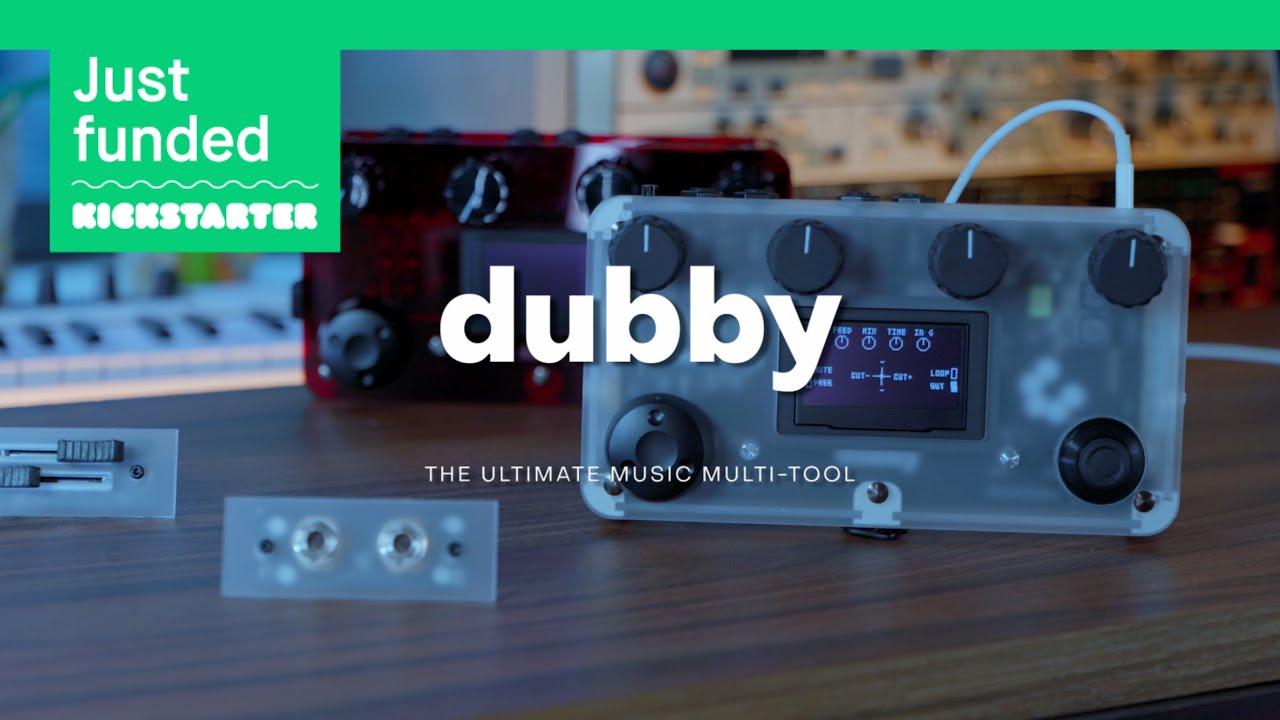
Dubby is now funded! I’m very interested in this one
I think they do investigate. They probably turn away the obvious corrupt scams, and that sort of thing. And there is a small amount of up front assistance to the creator. I agree though KS is responsible, and should do a better job to maintain a higher success rate.
There are other crowdfunders that do a much better job. As for instance Crowd Supply from Mouser. They talk about a 100% success rate,. Don’t know if that is still true. They do electronic musical products too.
The chords sound a bit dodgy, but the slides are wickedly good. It would definitely be a conversation starter if you showed up to the jam sesh with that. Everyone would want to have a go on it.
Also, it kinda looks like the Guitar Hero controller 
Yeah. Two notes only. But that’s better than one ribbon only.
It has no MIDI, at least as far as i can tell. I was doing the thought engineering to make something equivalent as a controller. That would be fun too.
Yes I fully agree. How many potential future backers will fly away from crowdfunding with such a bad experience ? I am one of these.
Me too.
One of the reasons i started this thread, way back when, was to help us all evaluate that risk. I’d say i am better at that now, but lost on this recent one.
Definitely Kickstarter the company needs to step up their act. I posted about them offering an optional failure insurance. That’s something relatively simple they could do.
I think should be part of their basic offering. Man it’s their job !! - to check and assess the risk these small companies are taking. You can’t just walk away with a simple warning to backers : “Remember you are not buying anything”. That’s too easy.
Paying for an insurance would be paying twice for the same thing : inform the potential investors of risks.
All excellent points bwo.
Both French companies, Expressive E and Aodyo, had investors to start their companies. So they’ve had a combination of funding. Aodyo, did an Indiegogo to make their first Sylphyos, and it didn’t make their target goal, it was about 1/3 funded but went ahead because they had used a “Flexible Goal” funding method.
The large delay with the Osmose, plus the pandemic, plus the choice to manufacture in China, plus the small amount of the upfront down-payment capital, plus the complexity, plus being so dependant on Haken, all put financial stress and increased the risk for Expressive E. They too had income from other products, their Touché, but they had to have depended on their investors deep pockets.
I know less about the investors ( the regular sort ) that Aodyo had, but the impression i have been left with, is that they were less securely financed, hence the scramble at the end looking for a rescue. As i indicated in another post it could well have been an original investor who pulled the plug.
The overlap of projects, is different in my opinion. In normal development, you constantly look for ways to spin off parts of a project so that they can help finance the larger goal. Perhaps if this could have been better anticipated, launching Loom first, completing that, and then using that tech and the income stream, with the Omegas. Hindsight is 20/20.
ADDED : This was the strategy used with the Anyma Phi software technology then being scaled into the Omega.
Loom is still a good product, and now that the features and design for it has been so clearly laid out ( plus that the technology for it is well established ) we may well see that product somewhere else, thanks to the kickstart.
Dubby fully funded from day 1
Osmose was not a crowdfunding campaign but an early-bird pre-order through their own website. Any customer could cancel anytime and get reimbursed. That’s why I think that the pre-order funding was mainly required to prove the existence of solid demand to investors.
The pre-order campaign also suggested that the product was close to the finish line in late 2019. Despite the software not being in the final hardware casing yet, EE was able to show videos of a prototype test-driven by pro artists.
Of course, EE could have gone bankrupt anytime and those pre-orders would have been potentially jeopardised. The reliance on toll manufacturing in China combined with the challenging logistics and components sourcing, all under the full pressure of the Covid crisis, was a huge risk.
Finally, I think the Haken dependency helped them a lot. For one, instead of just shipping a bare-bones controller, they were able to advertise an expressive instrument. Plus, Haken’s reputation for expressive synths certainly helped raising the credibility of the Osmose.
That’s crowdfunding. Money left my control and went to theirs. I keep my money in a pre-order until the product ships.
No, legally, early-bird pre-order is not the same at all as crowdfunding. That’s because early-bird pre-order is no different from pre-order: you stay in control of your money until shipment (at any moment) or until the firm goes bankrupt.
No it is crowdfunding, there are plenty of crowdfunds that will return your money before shipment including some Kickstarters.
We will obviously continue to disagree, i don’t need to post.
The legal and contractual terms between a pre-order purchase and a crowdfunding pledge differ considerably. A pre-order is a commercial transaction, usually governed by consumer laws, while a Kickstarter pledge is not. Consider the latter a promise to be converted into a future pre-order.
Bringing it back to the EE vs Adoyo comparison, the Osmose was close to a production prototype when the pre-orders were launched, while the Omega unfortunately never made it to this final development stage.
A pre-order is not “crowdfunding” in the Kickstarter sense though. In the case of Osmose, legally the transaction is a sale that comes with all the customer protections already existing regarding … buying anything. So the relationship between Expressive and their client pre-ordering is not ambiguous legally.
- The legal relationship between Project creators and backers
The problem with crowdfunding as “engineered” by platforms such as Kickstarter is that their TOS run around the bush, to make sure they stay as vague as possible regarding the nature of “backing”. What is “backing” legally? To this day, the justice system has not even decided yet, or so it seems in US at least.
Fun fact is that, when Zano project (a drone) failed after a successful campaign and the company went bankrupt (UK), backers were deemed “unsecured creditors” therefore clients of the company that was building Zano. But it’s just in UK.
- The ambiguity is by design
I see a lot of debate online about the nature of “backing”, some people call it “investment”, “charity”, a sale and then others argue that “Kickstarter is not a shop”, so it’s crazy to me, that neither Kickstarter, nor Indiegogo, were ever forced by any justice system to clarify what is the legal nature of the contractual relationship between the project creator and the backers, once and for all. Simply because no backer ever SUED Kickstarter directly.
Again, that vague wording is 100% by design, here are the TOS:
At no point Kickstarter ever defines what legally constitutes “backing”, which is strange, because the first job of an agreement is to define words used in that agreement legally.
- The legal relationship between Kickstarter and backers
To me it’s simple: If the goal of the Kickstarter is building the reward/perk backers chose, then it’s a sale and the project page is using Kickstarter as a shop, period. Unfortunately, someone would have to sue KS for a judge to finally compel KS to treat backers the exact same way any online shop does, as KS. client
Or KS would have to claim something along the line that they are just a company providing marketing services to the project creator (therefore making the project creator KICKSTARTER’s client), and any other contractual obligations lies with the project creator, not KS themselves. But then, if Kickstarter’s clients are the project creators, what are “backers” to that platform?
If I buy something on Etsy, Am I Etsy’s client? or Am I the Etsy seller’s client? One thing is sure, Etsy can’t just say “nope, we have nothing to do with anything when our clients order on our platform”, yet that’s basically what Kickstarter does when things go south.
This is an interesting question and to me, it’s the legislator that needs to clarify things at that point (or a judge in common law countries).
We don’t know the detail, but as you probably know, michaeljk1963, there is a variety of business tactics that could have protected and isolated whatever happened.
Having separate corporations around the new crowdfunded venture separate from the existing business, prevents a failure from cascading. You see this tactic used all the time, for instance if you have multiple rental buildings you do each with separate corporations to prevent a large liability decision bringing the whole thing down. You probably could tell us better, but this is generally viewed favorably by courts and is not a sham transaction. This arrangement allows for money to still flow between branches, as investments.
The bankruptcy process has been broken for a very long time. As Jeanne just pointed out in the post just before yours, the bankrupted Adoyo is no longer allowed to make money selling products they have. The green parts of a business gets killed, rather than protected, which is counter productive and destructive.
Startups need good lawyers.
Kickstarter investors of failed projects need good lawyers now too.
Good points, but also, maybe and maybe not. Corporate entities are “legal fictions” meaning the law treats them as if they have a reality that they do not actually possess. In order to protect itself from the “cascading effect” of related corporate failures, creating the separate corporate entity is just the beginning. Implementing strict lines of financing, resourcing, employment, insurance, etc. can be a real drag on innovation and synergy. This would be necessary to prevent a creditor of one corporation from “piercing the corporate veil” into one of the other companies, which is not that difficult. Imagine if Arturia had a different corporate entity for every new synth that came out? Besides, you’d have to demonstrate that each separate company could stand on its own, without reliance on the other companies, which in this case would maybe not have been possible, since there is almost always an evolution in development (e.g. new company product is an evolution of ideas from old company), etc.
As to how crowdfunding works, it might be that kickstarter needs to have some rules around now any particular company can use funds it receives. For instance, there are probably rules that prohibit a company from using the funds from one KS project to finance another one (called “commingling”). The question, then, is what is the enforcement policy for KS? I don’t know.