Hi all.
Maybe i expected too much. But when i put a Sampled Piano sound from a Grand Piano into the OT and play it back in Chromatcic Mode i was kinda hoping it would retain the same tone throughout the Octave range. But it gets pretty bad fairly quickly away from the root sampled note.(i have timestretching turned off). I thought maybe of creating a sample chain and slicing it up. Is this the best method but the chain maybe 24 notes long and take up a lot of space.Cheers.
Well, OT tracks are always going to be mono.
You could sample long notes with tails into a sample chain so you can pick slices for different octaves. No reason why tails would be cut off, static machines can handle really long samples.
Honestly, if melodic and tonal content is that important to you, use a synth, or multisampler. (Thats what I do, i dont like the sound of chromatically played samples in OT)
5 Likes
Yes i edited just now realising static machines and longer sample chains. Mono im not so concerned about. I notice its not used much and i think i can see why now. Its okay for bigger sounds like a church organ but piano really catches it out. Pity.
Sampling melodic phrases made elswhere into the octatrack, for further treatment, now thats where the OT shines.
Yes. I fully agree. I can sample in longer phrases and its great. Just them single notes.
Pianos have 88x3 strings vibrating in sympathy, for every note played (ok, maybe they don’t all activate all the time, but it’s a useful rule of thumb). That’s a 264 oscillator additive synthesiser inside a wood + metal resonator body. Plus every hammer and damping felt is a distinct physical item and thus minutely different for every key on every piano. There’s no way a single sample pitched up or down even a couple of tones can do what a piano does. Even those lavish “tens of samples per key” sampled pianos don’t sound quite right compared with even a cheap upright in the room next door. Some of them sound amazing, of course but there’s something quite magical about being physically in contact with the wood (via the air)…
Sorry, I’m going off topic. 
8 Likes
Actually ages ago I sampled loads of really long notes (16bars) from my old old synths, each wave, some modulated, some with PWM etc. To get much more pleasing sounds from octatrack. Its a faff, but worth the effort. For synthy sounds anyway. Piano is always a pain the arse due to it being a pitched percussion instrument
1 Like
…timestretch capabilities are great for beats and otherworldly sounddesigns…
…if u need more natural accuaracy in harmonics, samplers remain samplers…even with liquid audio options…
truu piano IS always asking for multimappings if u want it to remain truu as much as possible…so sample chains are the only way on the ot…
good news here…static machines can ALMOST do everything that flex machines can offer…
and once streaming from card, lenght is never an issue…
so freeze the sweetspots u want once upfront and never look back…
3 Likes
pitch shift algorithm isn’t the best on OT, best get a MPC or a 1010 Blackbox for true multi sampled / multi velocity instruments. Its not the OT best feature at all, its more for one shots + clips/loops etc
1 Like
I’ve been through a few. Nord Grand and others. I know exactly what you mean. I wasn’t expecting much but the drop off was quite rapid.
1 Like
Cheers. Thats my next step. Im working on it.
just use a sample with 8 octaves and use slices, works like a charm. also just to clear any confusion, your samples are stereo but the octatrack itself is monophonic.
1 Like
The OT may be monophonic but it is not monaural, so it is capable of stereophonic playback.
1 Like
Yep. To save RAM, reduce sample length with a faster decay, or use mono samples.
You can also use use static machines and much longer files, but they are clicky while playing live. Not clicky once recorded or plocked.
IIRC this Rhodes sample chain I made with OT was around 45MB (stereo, faster decay)
64 chromatic slices, 5 octaves and 3 semitones.
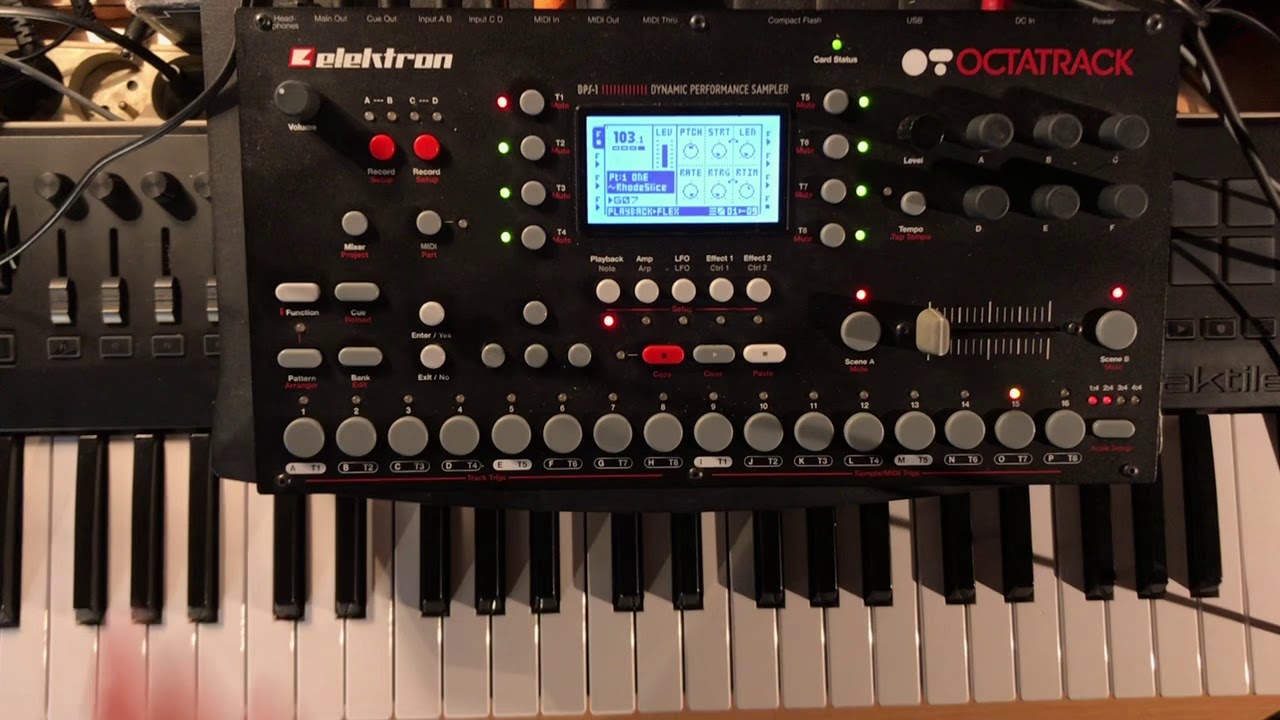
5 Likes
Thanks for the example Sezare. When it comes to editing the slices do you go through each one manually and then save somewhere? Is the slice information saved. Just so it doesnt get lost and can be recalled later. Cheers
make sure every sample is the same length in your daw, and put an even number of samples. then you should be able to slice it. the octatrack saves the slices, so you dont need to do it again.
1 Like
I used Rhodes samples, sample locked on a track. 64 steps, played at 30 bpm, scale 1/8 or something. Adjusted Release, Hold set to min. Resample, done.
I applied a 64 slices grid.
Trim/Slices/Attributes settings are stored in a file (.ot), generated with a recording or with FILE > SAVE SAMPLE SETTINGS
Settings are stored in slots, not with the sample unless you save sample settings.
3 Likes
Cheers. Now im going to pull out my Rhodes as youve wetted my appetite 
1 Like
You have a real one?
Ive gone through more keyboards than you can throw a stick at. The Rhodes Classic is somewhere around that i travelled with in the 80’s. Its in a case in the attic so should be okay. I started around the same time as Bob James was making a name for himself.
3 Likes