Reverb on pads is a subtle thing, in particular when the pad is both warm and dull. Alternatively, try a brighter or slightly distorted pad with a long decay plate reverb. Avoid too much reverb in the low end and slightly reduce the reverb in the higher end.
For inspiration, I get much better results laying a washy stereo delay over a pad. That’s because it can make it sound both chorusy and dreamy.
Very interesting. I once had some discussions with an older French composer for film/TV that also gets paid to do compositions to demo expensive sample libraries (ie, commercials to make the sampled instruments sound real). I was talking to him about how to achieve a natural sense of space in compositions, to make it feel like the instruments are all in the same space, and particularly mimic the sounds on certain old records. He interestingly told me not to use reverbs, and instead use delays. He told me he had loads of very expensive reverb plugins and outboard gear, but that in his experience delays used correctly will deliver far superior results, and sound more period correct if you are going for an older sound. I’ve honestly come to rely on Seventh Heaven (Bricasti M7) for my mixes in the DAW, so haven’t been able to really make use of his advice, but I always found what he said very interesting and it seems to mimic what you mentioned.
Also, to keep this thread on topic. Interesting shoot out:
Just my first testing experience, need more time for get all sounds with this wonderful pedal, but I’ve got good long tailed reverbs with high levels of mid/bass reflections, tank mode on medium (in manual says this is for slow modulations), setting on the hall type of reverb and low mix level, but if you go higher in mix level the tails are unmanaged . You could move the others parameters as you like for other tastes, even the type of reverb, but key is med on tank mod, and higher levels on mid/bass those are reverb time as labeled.
Thanks for sharing! I know how the controls work, but I have to get used to it. Being more specific, I sure got some long reverbs, but finding the right balance of bass/mid/treble and cross is not that easy. I‘ve mostly cut most of the bass and went with low mid settings, but I‘m having fun getting to know the behavior.
Think of delay as a sniper rifle compared with reverb’s shotgun!
(Mixing secrets for the small studio)
I am not sure whether these tips apply for all kinds of music, such as for example ambient. There is indeed a difference between the creative use of reverb and its use as a mixing tool.
This, I agree, is the biggest challenge with the CXM. From time to time, I’ve had harsh tones come out of it that I just can’t tame. Although it’s part of its character, it’s not always wanted and can’t be dialed away. I think this is partly because it is a digital effect after all, with artefacts created partly by intent but not always.
I use it less and less these days, because its blessing is also its curse - well, okay not curse - but it has a very specific sound, even in Lexicon mimic context, and eventually everything I run through it becomes predictable.
But that siren tail it creates … I’ve found nothing like it elsewhere, on hardware or in software. When you want that voice, there’s just nowhere else to go. Which is why I’m hanging on to it after having it since launch (well, since you could get it in Sweden after its launch, which wasn’t on launch day).
Extreme parameter settings can cause the Hall 224 and Chamber & Plate 224 reverb effects to self-oscillate or cause other unexpected sounds. This behavior is identical to the original 224 hardware and is caused by its internal 12-bit architecture.
Internal algorithm overloading can be especially apparent with very long reverb decay times. To reduce any artefacts, simply lower the reverb decay times with the Decay, Bass, and/or Treble knobs, and/or reduce the input signal level.
Note that with the Hall 224 and Chamber & Plate 224 reverb effects, the Decay, Bass, and Treble knobs control the reverb decay times for the middle, bass, and treble frequency bands.
Maybe the apparent issues observed with CXM are due to the combination of the algorithm’s behaviour and CBA pedals’ sensitivity to line level input? On the Golden, even though I tend to avoid extremely high reverb settings on all bands at the same time, the tones that come out of it are hardly ever harsh.
CBA’s Thermae on the other hand is uber-sensitive to line level. With direct connection, it immediately clicks and clacks, it often distorts and, even at medium feedback (past noon) and/or below noon filter settings, it will constantly enter self-oscillation until your ears fall off. While self-oscillation is certainly a feature of analog delays, the overly sensitive behaviour is not. Line level sensitivity and input level are to blame.
I use Radial Engineering’s StageBug6 in-between and this rids the setup of any clicking & clacking issues. If then needed, I engage its attenuator pad or reduce the volume on the synth to make the distortion and overly sensitive behaviour instantly disappear.
I’ve noticed that, that’s why I prefer keep reflection levels at 80% or 90% it could be ok too… and keep mix under 40-30% with those high levels of reflections. But if you go to 100% is when you enter in the threshold of the unexpected territory.
I’ve had mine over two years and still don’t feel I understand many of the more subtle interactions. So many of the properties are interdependent, and then there are “special modes” on top of that that drastically change behavior (Pre-delay with Lofi, low diffusion with hall, high diffusion with lofi…)
But generally, something that helped me immeasurably in getting the sounds I wanted out of it was to picture “Bass” and “Mids” as directly shaping the tails of their respective bands as suggested, but see “Treble” as dampening in the tank.
In a way, this lets me work from right-to-left. When does the sound hit the tank? Pre-delay. How much of it goes there? Mix. How dampened does it get? Treble. How does it get divided on it’s way out? Cross. How long does it ring out once it goes? Bass/Mids.
Thank you for your nice summary at the end, very helpful!
The fact that the reverb bands are dependent on each other makes the process slightly less linear though, or as UA puts it: “when Treble is set very low, adjusting Bass has little result. Even with Bass and Mid at max, the decay time will be quite short with Treble at minimum because above the treble frequency, decay is very rapid.“
TREBLE is a good example of how the EQ is interconnected – even with MIDS and BASS at max, the decay time will be quite short with TREBLE at minimum.
I’m not sure why they use such complicated language for this (or why this complicated language is so similar between different 224 clones), but it’s not as crazy as they make it out if you just picture the “Treble” label as reading “Dampening” instead.
Then there is no dependency between bands. In fact, the only “bands” that exist are the two you create with Cross (that is: Bass and Mids). They are completely independent of one another and consistently only control tail length.
And then it makes perfect sense that, if the tank is excessively dampened, the tails are going to be quite small even if Bass and Mids are cranked because you can’t shape tails that never existed. No need to picture any complex modulation between frequencies or imagine some sort of EQ is going on.
I have no idea how it actually works under the hood, of course. But picturing it this way has given me intuitive control over a device that, for me, involved a lot of trial and error before.
Isn’t the Lexicon 224 the only one that could compare? I understand it’s not a 1:1 replica but in terms of usage and sound there’s not much. The only exception I see here are the 3 different quality settings.
In terms of sound alone, and if trying to avoid the 224 replicas, including IR based based verbs, then just Valhalla Vintage Verb has out as an “inspired by” plugin with different era settings that would be similar to the 3 quality settings.
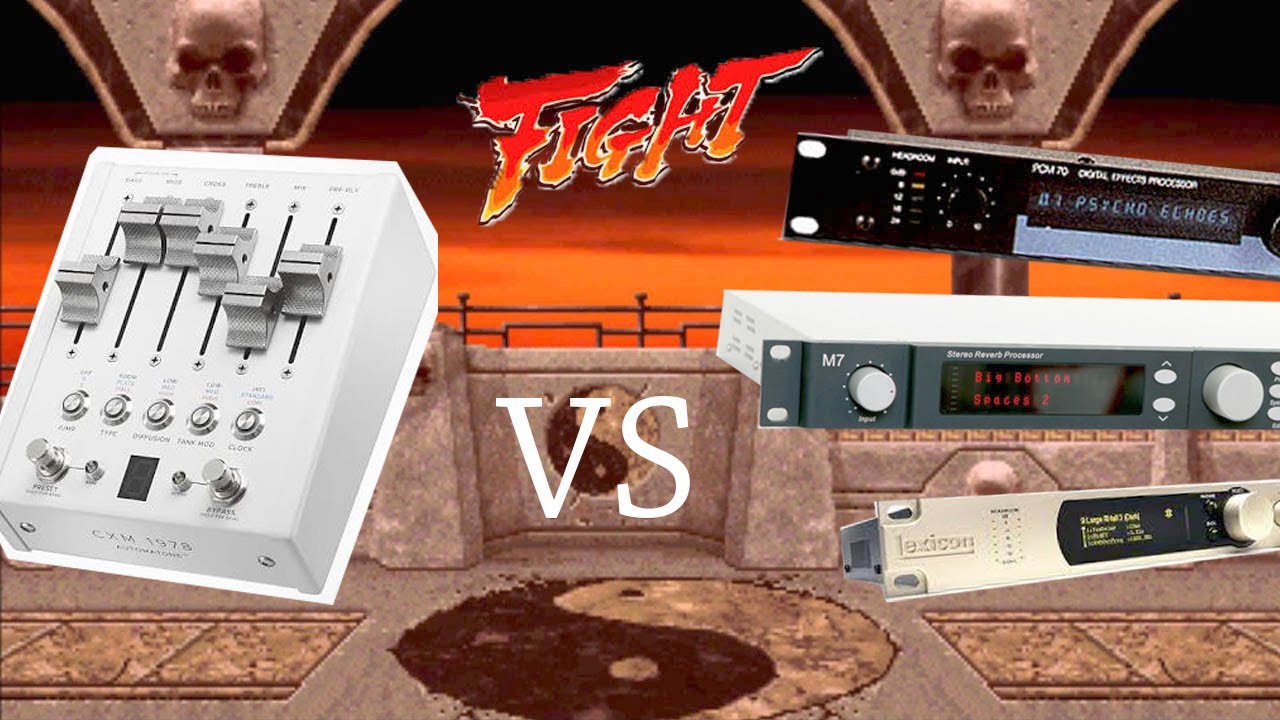
 . You could move the others parameters as you like for other tastes, even the type of reverb, but key is med on tank mod, and higher levels on mid/bass those are reverb time as labeled.
 .
.