Taiga has one.
1 Like
Nice I gotta try that.
My first synth, the Alesis Micron, allowed you to use different LFOs as a S&H source. Thought that was pretty surprising given that it was so cheap yet had this feature that for whatever reason doesn’t exist on a lot of (most?) VA synths.
I think a current version of that synth was released by Akai under a different name. Can’t really comment on the build quality. Can’t really comment on the sound quality either because it’s been so long since I used the Micron.
Also why the exclusion of semimodular?
2 Likes
I guess my exclusion of semimodular and I guess modular was because that is what I expect from them if they have a sample and hold, so its mostly the norm there… where as on desktop/keyboard synths it is more of the norm just to have them routed up with a random source.
1 Like
Depending on where each S&H “cell” is pulling the signal input voltages from, when the clock input is goes HIGH, it will aample the current voltage at the SIGNAL input.
The clock input just controls how often the signal input is sampled.
So on a normal S&H, if you run a slow triangle wave into the signal input, you’ll get a stepped triangle out. The step size is based on the clock speed.
The relation between the input wave frequency and the clock will determine if you get something like a glissando, or something that sounds like controlled random.
The 300 Wogglebug has two S&Hes. I’ll see where it pulls the input signal from. It’s something internal I believe.
You’re correct in that if you run audio in, you’ll get a bit reduced effect kind of, as the clock input has a comparator on it. So as the audio gets above that 1.5V threshold, it triggers the S&H to pull from the signal input, but since it’s audio, it will do this close to audio rate. So almost like a low rate PWM sample as you alluded to, but not quite a sampled and held waveform.
The Woggle has some interesting logic, summing, XORing (ring mod) etc. internally, which make the interesting modulations and audio outs. It’s not quite a typical S&H though. It could be quickly modded to add that function to a switch and jack, but there’s no way I could bring myself to cut into a 300 module. Making a separate module that could do more typical functions like this, and interact with the Woggle as an Expander would be quite fun however.
3 Likes
The Syntrx has this functionality too.
I mean the S&H can be set to sample the lfo.
2 Likes
I think Sequential uses random source, so the difference being even if you use an lfo on mod destination the result is variable rate or depth of S&H on a random/noise type source, vs being able to grab segments from a more controlled modulation source.
1 Like
A Random Generator in the context of a Sample and Hold couples an analog white noise source with the Sample and Hold. So that takes up the signal input of the S&H. This means that all you have control over is the speed (clock rate) and possibly level (amplitude of output signal).
A regular Sample and Hold would not be pre-connected to that noise source, so either without the noise altogether, or a switch to select whether to run the noise or an external signal into the S&H. This way, you can run other signals aside from noise into the Sample and Hold.
For example, a handy one would be running a triangle wave into it. The slower the clock rate, the larger the steps in the resulting output triangle wave would be. The faster the clock rate, the smaller the steps.
For example, here’s what you’d see with a sine wave going into the signal input:
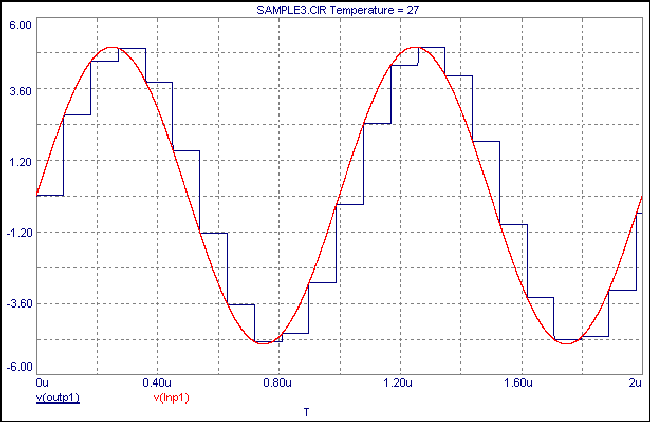
The reason that you generally get random outputs from most typical synth S&H is because the white noise going into it is random in frequency and amplitude, so each time the S&H samples, it’s getting a new random voltage.
If you input cyclical signals though, you get very interesting results. Either stepped audio waveforms, or cool stepped modulation, which when controlling say, the V/Oct input of a VCO will give you discrete stepped pitches, from slow repeating patterns to glissando type effects.
Here’s another good graph:
S&H.avif (9.5 KB)

Hmm, maybe that format doesn’t embed.
7 Likes
No problem!
Interesting about the Voyager too. Nice!
1 Like
What if you choose MODE=TRIG, SPD=32, and MULT=8 or above? You got your S&H that you can apply to any destination.
Every Elektron has such S&H modulation, if I’m not overlooking something.
Edit: oh wait, OP meant to sample and hold an input source. Oh.
2 Likes
The Voyager features inputs for both the signal to be sampled and the gate to trigger the sample&hold. So it is even more powerful as you can trigger the S&H at a given clock rate… or not.
The Moog CP251 also allows that.
On the VA side, but also kind of modular, the Clavia Mouldar series offers S&H modules in the same vein.
1 Like
Was going to reply Alesis Ion! This is such a fab feature of that architecture - the modulation in general is fantastic.
Roland SH-09
from VSE: “there is a sample-hold function which is great for voltage controlled filtering into acid and back”
And not a synth but the Moog CP-251 has a Sample+Hold.
Roland System-100 or its software equivalent which you can load (plug-out) to both the hardware System-1 and System-8.
On the System-8, you can set the S&H input source in the menu. On the System-1, you need to set this in the VST and then send the patch to the hardware.
1 Like
GRP A2 lets you point to LFO2 as the input for the S&H, and LFO2 can use a bunch of things as the source including a couple of shapes plus a bunch of other sources like VCOs, RM out, LFOs. Routing is a bit quirky but really powerful.
Unsurprisingly the A4 has a bunch more options.
1 Like
Sample and Hold circuit has three parts.
1.An input : this the sample bit. As in, ‘listen to this signal’.
2.A hold: or clock, as in, every time a pulse or clock is recieved, ‘sample’ the signal at the input and hold that value until the next clock pulse.
3.An output : where do I want to send the signal.
A true sample and hold circuit allows all 3 of those components to be patched from any where to anywhere.
A random LFO is just that. An LFO, with a random shape. Totally different thing to S&H.
2 Likes
Ah the CP251! I knew I had owned something that had this in a commercial product.  That’s what it was. (aside from modular of course)
I’ve not really explored the Lifeforms SV-1’s S&H as much as I should, but it’s rather nice that it has both sample + hold input jacks as you mention.
This thread is very inspiring.
Time to experiment then 
Try triangle LFO to input, gate into hold, output to filter mod in. Then replace LFO with an oscilator…
Then play some notes and tweak. That should free the mind up from the usual random voltage that most S&H patches seem to imply.
1 Like
This sounds like a lot of fun; and I’ll try the same with the MS-20M as well at some point too - handily it’s also been modded (not by me) to have Osc 1 out as well.
Hmm… I don’t think the SH-09 has a S&H module whose source can be selected. It’s just a vanilla “random modulation source”.
2 Likes