Arcade Fire – Funeral (2004)
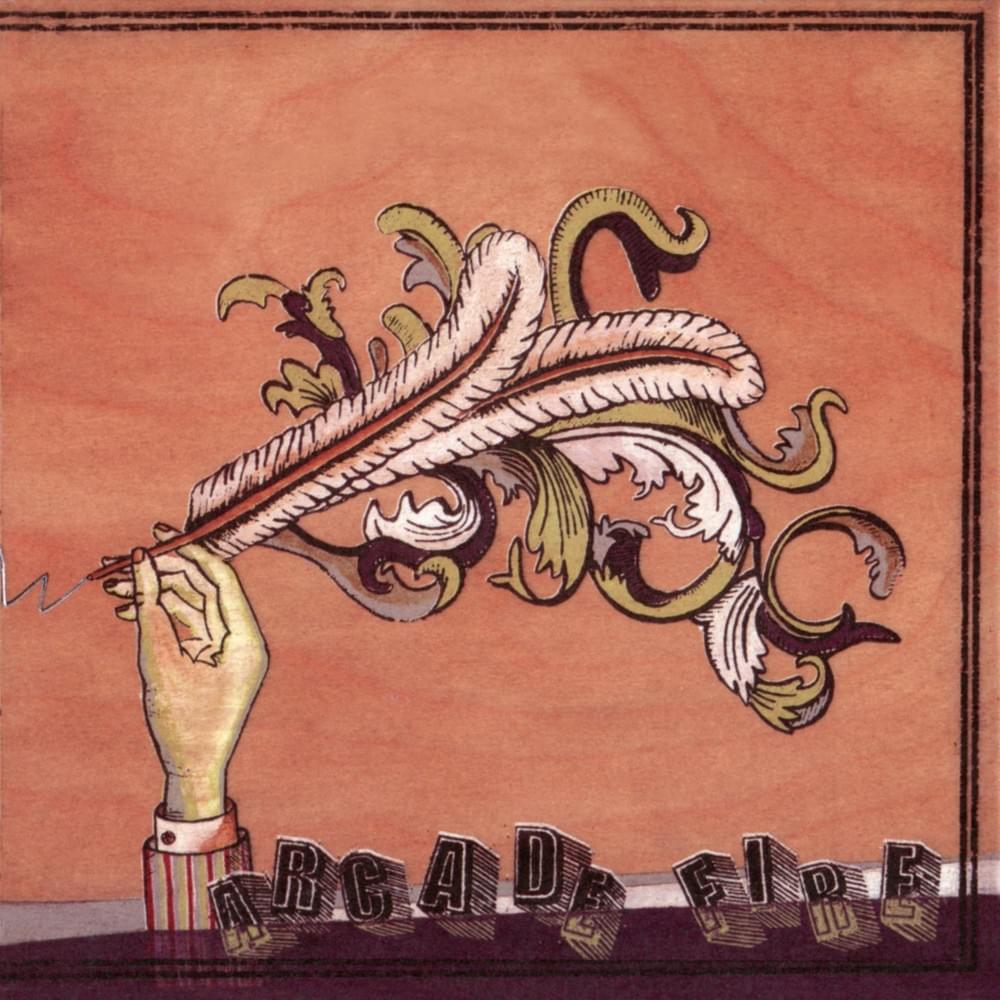
If I could only choose one album that defines me, it would probably be this one. Or to be more precise: it’s definitely the album that I’d say defined me for the longest period of my life. Heck, it’s the only album that I felt sure enough about getting a tattoo inspired by it. It was my gateway into indie rock, which became the dominant genre in my life. It made me dance. And it was in some sense at the heart of my most important friendships at the time. It’s also an album that breaks my heart, because much of what I loved about it has vanished by now.
I discovered this album in the winter of 2006 and distinctly remember first listening to it while painting the walls of my childhood room white. I was standing in an empty room covered in plastic foil, with my stereo system blasting in the middle. I was renovating my room a bit so that it’s less childish and thought these work sessions would be a good opportunity to try out some new music. I remember listening to two albums from that year that got a lot of hype, “Waiter: ‘You Vultures!’” by Portugal. The Man (which finally clicked then) and “Ys” by Joanna Newsom (which sounded interesting but would take me years to finally appreciate). Arcade Fire’s “Funeral” was in another league though. I think I had heard it before on my first vacation trip with friends that summer, when we would swap music selection duties. I think it was mostly me and my friend T. who took care of the music, since we were the most dedicated listeners of the bunch. I vaguely remember being intrigued by Arcade Fire’s sound that sounded very distinct but didn’t ask T. to listen to it some more or for him to give me the album after our vacation. But a few months later, it seemed fitting to choose “Funeral” as my selection of albums that could push me in new directions.
I was immediately blown away. Just like with “De-Loused in the Comatorium” two years earlier, it felt like I had just been waiting for “Funeral”. Like “De-Loused”, it became my album of that winter. And like with “De-Loused”, the band was just about to release a follow-up in March. And like with the Mars Volta, I might have missed the hype surrounding their debut but still managed to get on board before the band went on a streak of releasing genre defining albums. If I had ever joined a fan club, it would have been for those two bands.
But what was so captivating about “Funeral”? It’s hard to tell in retrospect, but I think the overall sense was that they managed to translate the melancholy and grand gesture I loved so much about Sigur Rós into pop songs that were fun and made you want to dance and hug people. This is a dark album that was born out of death (another parallel to “De-Loused”). It’s called “Funeral” after all. It feels like a funeral party though (so much so that the band might as well have named themselves “The Lucky Stiffs”). And this felt exactly like the person I was becoming at the time: a melancholic romantic that liked to be alone and think about “the big questions”, but an optimistic goofball that just wanted to party, hang out with friends and have fun at the same time. I notice that I keep bringing up this duality in every text I write for this project, and I guess that’s because albums that “define me” need to represent both of these elements. And from 2006 to around 2014, “Funeral” (and Arcade Fire in general) felt like the epitome of that for me. Which is to say: they defined me in a profound way throughout the whole period of being a young adult.
Arcade Fire also were my gateway into indie rock, which was the defining genre for me during that time (and still is, if we accept a broad definition of the term). I’ve already mentioned that I had become a bit tired of metal and hardcore when writing about The Mars Volta and Sigur Rós, but only when I discovered Funeral did it become clear to me that I’ve found a style of music that I want to dominate my life from now on. After years of mostly listening to bands with four dudes playing guitar, bass and drums, often taking themselves a bit too seriously, Arcade Fire felt like a revelation in contrast. There were many more people on stage than I was used to, and a lot of them played a different instrument during each song. Which included not only standard rock instruments, but also strings, wind instruments, pianos, synths, a harmonica or a glockenspiel. And, of course, a motorcycle helmet that needs to be smashed as hard as possible while jumping around. Finally, there were women on stage, with Regine Chassagne playing a central role, often smashing the drums. And you feel that diversity and openness when listening to “Funeral”.
Part of the appeal was also that Arcade Fire were clearly an indie band that was wholly unique and had a vision, but they were also on a mission to become the biggest band on earth, unlike many of their peers. They wanted to make pop albums that would become part of the canon of all-time greats. It’s not an accident that Bowie or U2 were early ambassadors and then collaborators of the band. As a result, “Funeral” is a wildly ambitious and complex album, but it sounds catchy and effortless. At the same time, there’s nothing that makes you think the band is making concessions to a label or a potential mass audience. Win Butler sounds like a wet dog that’s been beaten a bit too often on “Funeral“, and he looked just like that on stage at that time. Arcade Fire were probably the last band that firmly believed you could become the biggest band in the world by just making great music and being passionate about it. And I think they were kinda right. There’s no way you can write songs like “Crown of Love“ or “Wake Up“ if you’re not convinced that these are masterpieces. Without that conviction, it would most likely just sound like overdramatic kitsch.
I don’t think I know any other band or artist that radiates passion like the early Arcade Fire. There’s some Youtube footage of shows shortly before they released “Funeral” and blew up. Even though the quality is so shitty you can barely hear or see anything, you immediately get the sense that these people poured absolutely everything they had into playing their songs. As if they knew they would die the next day. They play themselves into a frenzy and the crowd follows, and then they absorb that energy and push themselves even further. It’s hard to see how you don’t become a hype at some point if you’re playing every show like that. And when I had the chance to see Arcade Fire live for the first time at Southside Festival 2007, I understood it as my duty to play my part of the show as best as I could, to reflect their energy back to the stage by singing along every line and grabbing strangers to dance with.
In that sense, listening to Arcade Fire felt like a communal exercise to me. My friendship with T. deepened quickly during the time I discovered “Funeral“, and I‘m sure our love for this album played a role in that. During my last two years at school, T. reappropriated a little room beneath his mum‘s garage that his older brother had once setup for hanging out with his friends. Now me and my friends would spend most of our weekends there, drinking, talking and always listening to music. I got introduced to a lot of artists this way, since T. had been into indie rock for years at that point and would often play new songs. I remember hearing Animal Collective‘s “In the Flowers“ there, and I must have also been exposed to “In Rainbows“ and “OK Computer“ in that shed for the first time. But Arcade Fire was a constant, and we didn’t just listen to “Funeral“ together, but also talked about little details that we loved. Like how “Wake Up” or “Crown of Love” play their best moments only for a short moment, making them even more beautiful and letting you think “how good is that band if they can allow themselves to not repeat that bassline more often”. T. and I even had little inside jokes about the album. For example, we were often shouting „you better look out for love“ instead of „look out below“, because I misunderstood the lyrics for some time and we both agreed that line would actually be pretty great.
There was also a second friend group emerging at the time, and those friends were all as much into music as T. and me. Arcade Fire became a defining band for us. I didn’t connect with the people in my own class and up until that point, all of my friends were a grade above me. Luckily, there was another school in a town nearby that had a high school you could only attend till 10th grade, and then you had to pick one of two schools to graduate from. Luckily, there were a bunch of guys with metal shirts that joined my class, and I was happy to finally have some interesting people in my own class. Even better, they had more friends that were also into alternative music that came to our school the next year. We would form ever closer friendships over the next years and well into our twenties, and music was probably the main driver for that. I would become closest to F. and P., who I also played in bands with at different points. They knew a lot of music I wasn’t familiar with, and they thought and spoke about it critically. What was also new about this new friend group was that it included several women, and they were also really into music. Like with Arcade Fire having female members, this changed the dynamics of our friend group.
We would often go to concerts or festivals together, and we would go out to “indie parties“ to dance. We also threw a lot of parties ourselves, where dancing together was the main attraction. Sooner or later, we‘d always hit an Arcade Fire phase, because that was the consensus band we all loved. And “Funeral“ always was represented the most, because all but two songs on the album are danceable, covering a wide range of moods. There’s the obvious banger, “Power Out“, which was always a thankful song to play whenever you felt like the crowd is ready for the next level of intensity, because it doesn’t waste any time on an intro but starts at 100%. Then we have the most “indie“ sounding „Laika“, with its memorable finale „when daddy comes home, you always start a fight / so the neighbors can dance / in the police disco lights“. If you were looking for a chill mid set wind-down, “Haiti“ has you covered with its steel drums and dub bass. And of course, there was always “Wake Up“ and “Tunnels“, whenever you felt ready for pure, non-apologetic bombast.
What was so great about these sets we played in my friends’ parents‘ basements or my parents‘ barn, was the fact that there was no DJ and no audience that you had to be afraid of losing. So we could play all of the songs on an album and not just the same single over and over again. “Funeral“ was perfect for that. Because most of these songs are quite danceable but would still be a bit too long or unfamiliar sounding to be played by most DJs. Not having to care about that, we could blast a song like “Crown of Love“, that is a schmaltzy ballad for 3:40 minutes until it’s suddenly a disco song propelled by strings and a pumping bass. Or “Une année sans lumière“, which is also laid back for ¾ of its length but then erupts into the purest indie rock moment of the whole album.
Listening back to the album for this list, I was struck by how masterfully these twists and other moments are arranged (something I find is extremely important for me). If you focus on the strings in “Crown of Love”, you notice that they’re teasing the finale for some time. “Tunnels” basically riffs on the same few piano and guitar notes for the whole song, yet every element changes subtly over time until it has turned into a full-blown anthem. And speaking of anthems, every song has at least one line that you want to text people you love, shout from a rooftop or get tattooed. Just to name a few of them: “Is it a dream, is it a lie, I think I’ll let you decide” (Power Out), “You change all the lead sleeping in my head to gold” (Tunnels), “My eyes are covered by the hands of my unborn kids / But my heart keeps watching through the skin of my eyelids” (7 Kettles). As the whole album, it might sound corny on paper, but the earnestness and passion with which Butler and the band deliver these lines makes them hit. And then there’s closer “In the Backseat” sung by Regine, which distills a whole character and vibe into the line “I like the peace in the backseat / I don’t have to drive, I don’t have to speak / I can watch the countryside / And I can fall asleep” and then turns it into a tragedy. It’s “Funeral” in a nutshell and might be the best song on the whole album.
I could go on and on like this forever, because “Funeral” and Arcade Fire were so formative for me. Unfortunately, it’s hard to do so in 2026. Because it turns out Win Butler turned into a cliché of a rockstar after becoming famous with “The Suburbs” and dragging his 100m long mic cable into the crowd to be worshipped. Or to be more precise, the guy was probably always an arrogant asshole, you just didn’t notice within the context of the spectacle that was their shows and albums. In a way, I’m almost glad they haven’t released a good album after “Reflektor”, so I wasn’t as hurt when news broke that Butler had been a sexual predator for years. And when his wife Regine publicly defended him in a way you’d expect from a CEO trying to protect their business. I don’t know if it’s all of these things or the music itself, but it’s hard for me to listen back to “Funeral” (even more so “The Suburbs”) and not feel a bit cringe about the lyrics and the music from time to time. Some aspects that felt progressive to me at the time (“they have women on stage”) also look different to me nowadays (Win is front and center and the distribution of instruments is mostly gendered). It seems like a product of its time more than my last two picks “De-Loused in the Comatorium” and “Ágætis byrjun”. I don’t think I would identify much with it if “Funeral” was released today.
And yet, it’s still the album that has probably had the biggest influence on who I was and who I am. This album has been with me from my last years of school and throughout most of my twenties. It has helped me deepen existing friendships and find new ones, and it made me fall in love with dancing. “Funeral” has played a central role in letting me become a confident adult that‘s not afraid to love and be passionate about what he loves. An optimist even in the face of tragic events, who acknowledges bad things happen but tries to see the upside in them and refuses to let cynicism and assholes have their way. That might mean I can no longer identify with Arcade Fire but be thankful for “Funeral” nonetheless.
Quintessential track:
Wake Up
Might have also been:
- Animal Collective – Merriweather Post Pavillon
- The National – Boxer
- Sunset Rubdown – Dragonslayer
- LCD Soundsystem – Electric Lady Sessions
- Why? – Alopecia